Friday, May 1, 2026
Home Blog Page 110

OP-ED: Tourism Is Oversensitive To Political Instability And Pandemics

0
TOURISM

By Oweyegha-Afunaduula

It is true. Tourism is extremely sensitive to social political instabilities, because finally tourism is people – what they perceive and what they expect.

If a country is suffering human rights violations, extrajudicial killings, arbitrary arrests, silencing of the absolute majority of people, rising robberies, bad governance, oppression , suppression, depression, terrible pandemics such as Ebola, political instability and uncertainty, this will be reflected in the poor performance of tourism.

I hope some serious academics can study the complex interrelations of issues without oversimplification. Unfortunately the usual academic practice is to simplify and then hope to use the simplifications and their proposed simple solutions to understand complexity.

This is an institutionalized falsehood. That is why we have to rethink the way we have been doing things towards integration and reintegration of knowledge, sub served by critical thought and critical analysis.

Systems approach must be the only thing of the 21st Century. It engenders broader understanding of issues, problems, challenges and phenomena. Without such understanding we lack the wisdom to solve any problem. Our solutions continually become our new problems.

For God and My Country.
The Writer Is a Ugandan Scientist And Environmentalist

DISCLAIMER: The views expressed here are solely for and belong to the writer/author. They don’t reflect, portray or represent those of Accord Communications Limited, it’s affiliates, owners or employees. If you have a story in your community or an opinion article, let’s publish it. Send us an email via editorial@accordconsults.com or WhatsApp +254797048150

OWEYEGHA-AFUNADUULA: Celebrating a Century Of Existence: Is Makerere Unversity a Relic Of The Past?

0
Makerere University Ivory Tower

BY OWEYEGHA-AFUNADUULA

Unlike Cambridge University, which was founded in 1202 and has, therefore, existed for 8 Centuries;   Oxford University, which is the oldest surviving in the English-speaking word, thought to have existed since 1096; and Harvard University, which was founded in 1636 as Harvard College and is the oldest institution of higher learning in the United States of America, Makerere University, which started as a technical institute in 1922, recently celebrated its 100 years of existence. However, it remains as if it is a relic of the past.

All the ancient universities in the West I have mentioned have been the custodians of disciplinary education (i.e., education in small knowledge cocoons called disciplines), whose main preoccupation has been disintegration of knowledge to create academic empires for knowledge workers. As a result, information and communication have tended to be broken and packaged in small, disconnected, non-communicating cocoons of knowledge. Consequently, the academics have also manifested as if they are strangers in the same room: the University. Even when they form unions or associations to advance their interests, intercommunication between the academics is constrained by their belonging to small knowledges. They are even easy for power to manipulate them by use of divide and rule.

While in the ancient universities Interaction for cohesion and consensus has been difficult to achieve.  recently they have opened up to reintegration of knowledge, while newer Universities, such as Makerere University, have tended to re-entrench disintegration of knowledge in the 21st Century. Therefore, in the ancient universities, rigid separation of knowledges is no longer as valued as in the past. The new knowledge cultures of interdisciplinarity, transdisciplinarity, crossdisciplinarity and nondisciplinarity have been allowed to interpenetrate the university structure and function. Professionalism and its reproduction is no longer strictly disciplinary. Neither is career development strictly disciplinary as is the case in virtually every colonially and neo-colonially established universities of Africa. Here, non-disciplinarians are despised and inhibited in academic advancement.  This is treated as securing purity of knowledge.

In fact, for Makerere University, a new academic policy popularly known as the Akiiki Mujaju Academic Policy was innovated at the beginning of the new millennium to secure disciplinarity and the careerism that it entails. Apart from emphasizing holders of Ph.D. as the genuine generators of knowledge, and lecturers in a university the policy re-emphasized disciplinary research and education as the core academic culture of the University.   This, way the policy did not only block reintegration of knowledge in a century of integration, but propagated the falsehood that one cannot lecture unless one holds a Ph.D. although many Ph.D. lack the capacity to research and lecture effectively. In the past this was not the case. The University once had a professor of Geography who had only  a first degree, and many professors, including Professor Sentosa Kajubi and Professor Asavia Wandira, who were far more academically productive than present-day Ph.D holders.

I have heard many people saying Makerere University has stuck itself in the past. For example, Godman Okoye wrote an article in The Monitor (the precursor of Daily Monitor) of 5th August 2002 that Makerere University has remained 35 years behind. Thia was simultaneous with the emergence of the Akiiki Mujaju academic policy instrument. Okonye’s article was more or less saying that Makerere University had remained an early 20th Century University, and the Akiiki Mujaju academic policy instrument was stressing that it would remain so in the 21st Century. The roadblock to creativity and innovation has been fragmentation of knowledge and over emphasis of knowledge acquisition and knowledge transmission just to cure the knowledge disease.

Way back in 1992, New Perspective Quarterly cited Nobel Prize winner in Chemistry for 1977 saying, “The Project at the end of the millennium is to go against fragmentation ….. I sense that this is true in all fields”. Obviously Makerere was not listening to this great scientist. That is why years later it wholeheartedly the Akiiki Mujaju academic instrument and accepted knowledge fragmentation as of no harm to its body politic if carried over to the 21st Century. This is what qualified the university to be a relic of the past.

The question is “Can Makerere University shed its status as the academic relic of the past? Yes of course. Everything starts in the mind and ends in the mind before application. That’s how laws and policies start. If we allow learning “to manifest as the new form of labour, and do not continue regarding and pursuing it as as a separate activity that occurs either before one enters the workplace or in remote classroom settings, change of mind becomes a necessary phenomenon in the education enterprise. We can not strive for integration of anything when education continues to be designed for disintegration of the mind and the knowledge therein.

In his book “Who If Anyone Owns the Past? Reflections on the Meaning of Public History “published in 1992, Professor Bethwell Allan Ogot allocates Chapter 10 of the book on “Rediscovering Galileo or Who is Qualified to Teach in A University? That was long before the Akiiki Mujaju Academic Instrument was unleashed on the academic environment of Makerere University o continue emphasizing concern about individual or national economic competitiveness.

Prof. Ogot agrees that a Ph.D or its equivalent should generally be necessary for teaching in a University if quality in higher education is to be enhanced and a cadre of committed teachers, researchers, intellectuals and intellectual leaders produced. Unfortunately, in the Makerere of the 21st Century, emphasis is on academicism, far less on building the intellectual capital of the university and the country. Besides, although we continue to produce graduated in increasing numbers with Doctor of Philosophy degrees, the majority have the slightest or no grounding in philosophy. Professor Ogot states that higher education must engage in and stimulate others to engage widely philosophical and social issues of the public good.

If the University disengages itself from philosophical and social issues, preferring to preoccupy itself with academicism, then it will leave ignoramuses, mostly politicians, to make a mess of the public good by pretending to be the intellectuals clarifying and articulating issues for society and to be the philosophers of our time. Academicism will not produce for us self-confident, committed and well-trained scholars who can engage in critical thinking and alternative analysis. At best, they will choose to recycle rotten ideas or assume the stance of fear and conspiracy of silence. It is a big loss if a university is full of graduates who are fearful and choose silence. They leave the public space to manipulators and self-interested individual who easily cast lies as the truth.

Prof. Ogot uses Galileo Galilei to strike a balance between knowledge acquisition and transmission on the one hand and innovation and creativity on the other in our universities. At the age of 20, Galileo was not just taking in the ideas and teachings of his professors. He asked why, how and what, which were difficult questions for the professors who tended to recycle knowledge and ideas of Aristotle, Hippocrates and Galen rather than question, create or innovate new ideas. The professors were just transmitting ancient ideas of ancient thinker, which infuriated Galileo, making him to storm out of many lectures at the University of Pisa in Germany. He was also infuriated by his colleagues who never questioned the professors.

According to the story of Galileo, his father chose medicine for him but while agreeing to do medicine, he chose to ignore the “boring professors” and teach himself mathematics. He allocated more and more time on Mathematics. When he attended the Medicine lectures, he would annoy his professors and colleagues by asking proof of every statement they made. Eventually, for being a critical thinker and critical analyst, always demanding alternative explanations and proofs, and dismissing the widely-held view that whatever the books stated was true, he was expelled from the university of Pisa, thereby prematurely compelled to quit his medical course.

Prof. Ogot writes that one day while in class, Galileo asked his professor, “You say it is right because it is in the works of Aristotle, suppose Aristotle made a mistake?” Galileo was able to prove that Galileo as wrong. One day he ran to class shouting, “Aristotle was wrong. Now I can prove that he was wrong!” He proved it by showing that the small and big balls of the lumps swung at the same time and same rate and returned to the original position at the same time and same rate. Without training he was made professor of physics at the same university which sacked him. However, his old professors connived and had him leave the University. He moved to the University of Padua to replace a renowned professor who had passed on as professor of Mathematics.

Interestingly Galileo taught and supervised people who had had first and second degrees for Ph.D. degrees. Many scholars came from all over Europe to be taught and supervised by a professor without a degree of his own. He was like Jesus or Socrates who taught effectively without a degree.

Question is: why can’t people without degrees but with considerable broad knowledge and practical skills teach at a Ugandan University? Why should Makerere continue to be like Pisa University of the 17th Century, believing that the only source of knowledge in the 21st Century should be people who hold Ph.D? After all when students are put under apprenticeship of instructors in the field who do not hold degrees, they gain a lot towards completing their university education. In 1990s, my own father, the late Charles Afunaduula Ovuma, without a degree, taught Lusoga to Masters students in the Institute of Languages, by then headed by Professor Muranga. He was an essential resource for the Department.

If the 17th Italian University of Pisa is translocated to the 21st Century, and superimposed onto Makerere University, many Galileos – creative and innovative – would be rejected and ejected from the University.  This would make Makerere University not only a relic of the 17th Century but also the 20th Century since academic practices of Pisa and other similar universities of the 17th and 20th Centuries were more interested in knowledge acquisition and knowledge transmission than creativity and innovation. To create and innovate one had to seek refuge away from the academic environment.  Consequently, the University would be committed to acquisition and transmission of knowledge, far less to creativity and innovation, and to knowledge fragmentation rather than reintegration of knowledge. That would assign it to the status of a relic of the past, the same way the dinosaur is taken to be a relic of the past biological world.

When, in 1972, Jantsch advocated for interdisciplinary and transdisciplinary universities as a systems approach to education towards and in the new millennium, to deemphasize overspecialization and individualization in education, it was an integrative and integrated Makerere University he had in mind. Makerere can be retuned to be a truly 21st Century university -a university reintegration rather than disintegration. We need graduates that can be agents of and value integration. Those who are agents of and value disintegration are a danger to humanity and society as a whole. Uganda is currently a victim of agents of disintegration who were instructed and produced in small fragmented knowledges. Such graduates see and glorify small things, not big things. They do not know that the whole is greater than its parts and unlike any of its parts, separately and collectively.

Makerere University of the 21st Century must be for reintegration, not disintegration, of knowledge, and for creativity and innovation, not knowledge acquisition and transmission. Only then can it be useful to the ideology of integration, creativity and innovation.

For God and My Country.

The Writer Is a Ugandan Scientist And a Retired Makerere Don

DISCALIMER: The Views expressed in this article are solely for and belong to the author/ writer. They don’t reflect, portray or represent those of Accord Communications Limited, it’s affiliates, owners or employees. If you have a story in your community or an opinion, let’s publish it. Send us an email via editorial@accordconsults.com or WhatsApp +254797048150


OWEYEGHA-AFUNADUULA: The Fate of Political Integrity, Governance and Leadership- Social Development Jeopardized in Uganda.

0
Oweyegha-Afunaduula

By Oweyegha-Afunaduula

Political integrity is possible. It reflects character and honesty. Character and honesty without principles and morality is a myth. But in Uganda Principles and Morality are diminishing twin-virtues among our politicians and other categories of leaders.

So, to get one politician with “political integrity” may have to wait until Jesus comes back.

Increasingly, the governors of countries, especially in Africa, feel uncomfortable when there are people with integrity within their circles. Such people tend to be marginalized as much as is possible. Or else they are sucked into circles of people inimical to integrity and honesty. This might explain why telling the truth to power is a diminishing possiblity.

Power prefers lies and being mystified, praised and worshipped. This is far more true in Africa than was the case in Napoleonic times.

Consequently, to get governors who deliver social goods and services with the resources at their disposal comes as an accident. They prefer either to hide theirs heads in the sand or to preoccupy themselves with infrastructure, accessing natural resources for personal or family gain, building patronage chains or erecting laws that oppress, repress, suppress or depress citizens.

In Africa this might express as political ethnicization, ethnic politicization, deep State, exclusionism, witch-hunt, commercialization of politics, governance, leadership and the processes of erecting governors and leaders.

This is the end result of “killing” political integrity, character, honesty, principles and morality in a country’s governance.

Ultimately, if corrupt tendencies predominate in the conduct of governors and leaders, it will be difficult to fight the vice of corruption altogether. Everyone will not be free from the virus of corruption. That’s why in a recent article I surmised that corruption will be the ultimate investor in Uganda. I just fell short of clarifying and articulating that the corruption-guided investment will have its worst negative impacts in the social arena (education, health, agriculture).

Already, the majority of Africans in general and Uganda in particular are excluded from social development. Social development has been unfairly institutionally privatised for the benefit of a small group of people.

Power tends to protect the small group of people and endow its members with every opportunity in every sphere of life.

Interestingly, the governors and leaders will not accept that they have lost touch with the reality in the country, especially with the pace of social development in the disadvantaged social strata.

There is need to rethink governors, leaders, social development and the vision of development adopted. Later will be too late.

For God and MY Country.

The writer is a Ugandan Scientist And Environmentalist

DISCLAIMER: The views expressed in this article are solely for and belong to the writer/ author. They don’t reflect, portray or represent those of Accord Communications Limited, it’s affiliates, owners or employees. If you have a story in your community or an opinion article, let’s publish it. Send us an email via editorial@accordconsults.com or WhatsApp +254797048150

Ugandan Companies Shortlisted For Digital Transformation Awards

0
James Kizza (Right) Assistant Commissioner IT, Uganda Revenue Authority receiving the East Africa's CIO of the Year Award from Joe Mucheru, Kenya's ICT Cabinet Secretary

In its drive to steer digital transformation, dx5 (Formerly CIO Africa) has released a shortlist for companies that will compete in the Digital Transformation (dx100) Symposium & Awards which is slated for 23rd to 25th of this year.

Now in its 14th year, the Digital Transformation (dx100) Symposium & Awards celebrates 100 organisations (and the people within them) that are using information technology in innovative ways to deliver business value.

The shortlisted companies have been drawn from a pool of over 350 firms that had earlier submitted their applications to be recognized in the Awards. The list will be further trimmed down to a hundred who will be awarded as the top 100 companies in Africa that have embraced digital transformation in their projects.

Safaricom Director of IT services George Njuguna was named CIO of the Year 2018

The companies will go through a rigorous adjudication process where a panel of judges will select the top 100 of the lot in different categories.

The shortlisted companies are drawn from different countries across the continent including Kenya, South Africa, Uganda, Mauritius, Rwanda, Nigeria, Zambia, and Egypt.

This edition of the Awards which feature winners from different categories include Healthcare, Government/ Public Sector, Education, Insurance, Hospitality, Manufacturing, Media, Transport, Banking, and SACCOs. New categories introduced this year include Retail, Telecommunications, Agriculture, and Non-profit.

The finalist companies that will be participating in the Digital Transformation Awards include:

The Banking sector: Equity Bank, ABSA Kenya, Kenya Commercial Bank (KCB), Gulf African Bank, and Sidian Bank.

The healthcare sector: M.P. Shah Hospital, Gertrudes Children Hospital, and Dawa Lifesciences.

The manufacturing sector: Car and General, Mabati Rolling Mills, British American Tobacco (BAT), Unga Holdings Group, and Isuzu East Africa.

The public sector: Kenya Airports Authority, Kenya Electricity Transmission Company Ltd (KETRACO), Energy, & Petroleum Regulation Authority (EPRA)

The insurance sector: Jubilee Insurance, Motisure, Kenya Reinsurance Corporation, and Takaful Insurance

This edition of the awards has attracted companies outside Kenya showing how digital transformation has grown in the continent. The shortlisted companied that are outside Kenya include:

Weber Wentzel (South Africa), Smart Africa (Rwanda), Infobip (Project for Zenith Bank) – (Nigeria), Jelurida Africa (Nigeria), Thochima Enterprises Ltd (Zambia), Inq Digital (Mauritius), Platino Group (Egypt) and Billionaire Fund (Uganda)

dx5 Chairman Harry Hare commenting on the shortlisted companies said: “We have received applications from countries we never received from before and sectors we didn’t award in the past. This shows how technology continues to be adopted in the continent with countries like Mauritius, Zambia, and Uganda showing that they will not be left behind with the digital transformation bandwagon.”

The Digital Transformation (dx100) Symposium & Awards event will be hosted at Leisure Lodge, Diani, Mombasa.

Some of the anticipated speakers include tech luminaries such as Jack Ngare, Technical Director Office of the CTO, Google, Ali Hussein, Chairman of the Association of Fintechs in Kenya, (AFIK) and CIO of the Year 2018 winner, George Njuguna.


Minister Amongi Calls for Better Protection of Women and Girls against HIV

0

The alarming new HIV infection numbers among adolescent girls and young women require dedicated leadership and prioritization of the needs of girls and women in the national response plan, the Minister for Gender, Labour and Social Development, Hon. Amongi Betty Ongom, has said.

Citing studies by UNAIDS and the Ministry of Health, Amongi noted that while the country had previously made tremendous strides against the epidemic, recent trends indicate that there are unacceptable numbers of new HIV infections among adolescent girls aged 10-19 years and young women 15-24years.

“Estimates show that 98% of new HIV infections among 10-19 year old boys and girls – occur among girls. And 78% of all new HIV infections among 15-24 year old young men and women occur in women.” the Minister noted, adding: “This is quite devastating and indeed calls for a dedicated team of Leaders who can champion a reversal of this narrative.”

She made the remarks while speaking at the High-Level Meeting on Championing the Priorities of Women and Girls in the HIV Response held in Dar es Salaam, Tanzania on Tuesday 11th October 2022.

The meeting held under the auspices of the Government of the United Republic of Tanzania and UN Women with support from the U.S. President’s Emergency Plan for AIDS Relief (PEPFAR) brought together emerging young women leaders from 15 African countries – where girls experience the highest risk of HIV infection – to meet with women ministers of health, education and gender equality.

In her remarks, Amongi raised concern that women and girls spend more than 4 hours daily ensuring that family members or other members of the community are free of the distress and discomfort occasioned by HIV and AIDS.

“This means that adolescent girls and young women in Uganda continue to bear the brunt of HIV and AIDS.” She said.

She enumerated that as a Ministry in charge of Women and Girls Affairs, her Ministry started participating in the HIV response in Uganda as early as 2008- only a few years after the introduction of anti-retroviral therapy.

She revealed that following the High-Level Political Declaration and Commission on the Status of Women (CSW) Resolution on “Women, Girls, HIV and AIDS” in 2016, the Ministry of Gender, Labour and Social Development finalized the National Action Plan on Women, Girls, Gender Equality and HIV/AIDS to provide leadership in addressing the needs of women and girls in the national HIV response.

A roadmap combining HIV Prevention and multi-sectoral action framework 2019-2025 was also developed with the intention to eliminate new HIV infections among adolescents and young people

In the same period, a Presidential fast-track campaign prioritizing HIV reduction among women and girls was launched to cover the years 2020-2030.

She commended a team of eight bold young women living with HIV who in 2014 mobilized colleagues and started a beauty pageant to challenge HIV-related stigma, exclusion and discrimination. The pageant tagged the Y+Plus Beauty Pageant has become an annual campaign that climaxes on the eve of the 16-days of activism against Gender-based Violence every year. The Team is organizing the 9th audition that was launched on 30th September 2022 and will climax on 23rd November 2022.

Many seasons have run with themes tackling stigma, mobilizing peers, demanding opportunity while the current theme is “Pass the Mic, we got the Voice”.

“In there, young women and boys living with HIV demonstrate that they are capable leaders, ready to take up responsibility, be accountable and contribute to an HIV free generation.” The Minister noted.

She hailed the intervention for creating a pool of young people who are mentored as future leaders and influencers in the HIV response. It also provides an unmatched platform that allows intergenerational dialogue on matters of adopting HIV preventive behavior, breakthrough in HIV prevention Science, psychosocial support and mental health, the debate around sexual and reproductive health rights for young people besides providing resource persons for youth-led HIV service delivery approaches.

The meeting, also attended by Ms. Winnie Byanyima, Executive Director, UNAIDS, will culminate in a set of recommendations for policymakers to take forward to help reduce the incidence of HIV among adolescent girls and young women in their countries.

If you have a story in your community or an opinion article, let’s publish it. Send us an email via editorial@accordconsults.com or WhatsApp +254797048150

Making Journalism Professional Again

0

As Journalism in Uganda faces the dilemma between being professional or picking on local talent as well as social media influencer who may not display the required media ethos or professionalism University’s in Uganda have the task to produce well grounded professionals able to meet the creative, business and social acumen necessary to beat the competitive media industry.

It’s on this note that the Africa Renewal University a Christian University located in Buloba, a Kampala suburb offers it’s students practical skills in radio, television and print production to match the industry and job market demands.

Oliver Taremwa Seated In The Middle At The Table With Judges Who Were There To Mentor The Students

Olive Taremwa a lecturer in the Department of Journalism and Multimedia at the University explains that the activity which is dubbed the ‘media fest’ is undertaken at the University to ensure students are practical, confident and able to fit the job market when they complete.

If you have a story in your community or an opinion article, let’s publish it. Send us an email via editorial@accordconsults.com or WhatsApp +254797048150

OPINION: Poor Man’s Energy Source Is Solar Energy, Not Hydropower

0

By Oweyegha-Afunaduula

I have been on Earth for 73 years and the only prison I know was the womb of my mother in 1949. My views are always very close to what God wishes me to say. They never include belittling leaders. I only tell them alternative thought.

I think I can thank the NRM regime for allowing me to express my views for over 30 years consistently, persistently and enduringly. And I thank God for giving me a long life. What I say s not destructive but constructive.

One time I told World Bank and Government of Uganda that they should spare Bujagali Falls and develop solar power – the poor man’s energy. Together they chorused that if I wanted solar power I should contact others but not them.

That was almost 23 years ago. Today when they talk about solar power it is as if they never opposed my view. With passage of time they are on the same side with me. Time the best judge has proved me right. The poor man’s energy is not hydropower but solar power.

For God and My Country.

The Writer is a Ugandan Scientist And Environmentalist.

DISCLAIMER: The views expressed in this article are solely for and belong to the author/ writer. They don’t portray, reflect or represent Accord Communications Limited, it’s affiliate, owners or employees. If you have a story in your community or an opinion article, let’s publish it. Send us an email via editorial@accordconsults.com or WhatsApp +254797048150

OWEYEGHA-AFUNADUULA:21st Century Uganda Needs Enabling Laws, Not Repressive or Oppressive Laws

0

By Professor Oweyegha -Afunaduula

Many years ago, the National Association of Professional Environmentalists (NAPE) launched a magazine called NAPE LOBBY to popularise issues of environmental justice, environmental democracy, environmental bankruptcy, environmental corruption and environmental politics in development, transformation and progress.

It was a difficult time to venture into these issues because we had already some oppressive laws such as Terrorism Act and Sectarian Law, which could be used against environmentalists to silence them. Indeed many times they were dubbed by the President himself as development saboteurs every time they tried to do their work.

One time many environmentalists were arrested when they contradicted government’s choice of sugarcane for Mehta in Mabira Rain Forest’s ecotonal fringes. For government it was development if a sugarcane plantation of 7100 hectares was established in the ecotone of Mabira Forest. However, Uganda was far more an open society than it is now.

There was more tolerance. Even by 2012 NAPE could still publish its NAPE LOBBY without fear or favor for environment in development. For example, the NAPE LOBBY of February 2012 cover page carried “Dubious Deals in Africa: Uganda’s Experience”.

On pages 4 and 5 there was an article by me “GOVERNANCE: DUBIOUS DEALS IN UGANDA’S OIL INDUSTRY”. That was long before Nereko’s Social Media Bill was passed into law and assented to by President Tibuhaburwa Museveni.

There is far much more conspiracy of silence today than then and Nsereko’s initiative entrenched the conspiracy of silence further, of course to the detriment of future generations of Ugandans who will never know how truth and wrong were tested and balanced during our time under a cloud of fear.

This generation is being taught truth can be untruth if the powers that be decide so. If you want to read that article I wrote long ago, go to NAPE’s internet web page nape.or.ug/publications/nape-lobby/67-dubious-oil-deals-in-africa/file.

One thing is true. Africa will never ever develop because we hate doing things right in a straight forward way. We like engaging in dubious deals. That is why the President of Uganda recently sacked the leadership of Uganda Railways. The vice is widespread in and outside government. The President alone or with his Inspector General of Government cannot subdue it. It needs all of us to confront it. However, we cannot do it effectively in a socio-political environment choked by oppressive laws that generate fear among leaders and the led. We must begin to concentrate more on making enabling laws. If we continue to prefer oppressive laws time will come when we shall fear rather than love one another from bottom to top. Or else fear will disappear and we shall begin to do what we used to fear doing. I can see a situation developing where people will no longer fear laws such as Sectarianism law and Anti-terrorism law, especially if it becomes apparent to them that the laws serve narrow interests.

We are in the Cyberage which requires more openness of society to make any meaningful progress and influence in a century that demands greater interconnectedness, broader knowledge, greater information and greater meaningful and effective communication vertically, horizontally, internally and externally in a globalised world.

We cannot, and will never, be an island. Even islands we in the natural sciences call “ecological islands” are open and interact greatly with the outside world as much as they do internally.

For God and My Country.

The Author Is a Ugandan Scientist And Environmentalist

DISCLAIMER: The views expressed in this article are solely for and belong to the author/ writer.  They don’t reflect, portray or represent Accord Communications Limited,  it’s affiliates, owners or employees. If you have a story in your community or an opinion article, let’s publish it. Send us an email via editorial@accordconsults.com or WhatsApp +254797048150

FUFA Equips 35 Media Officers With Communication And Marketing Skills

0
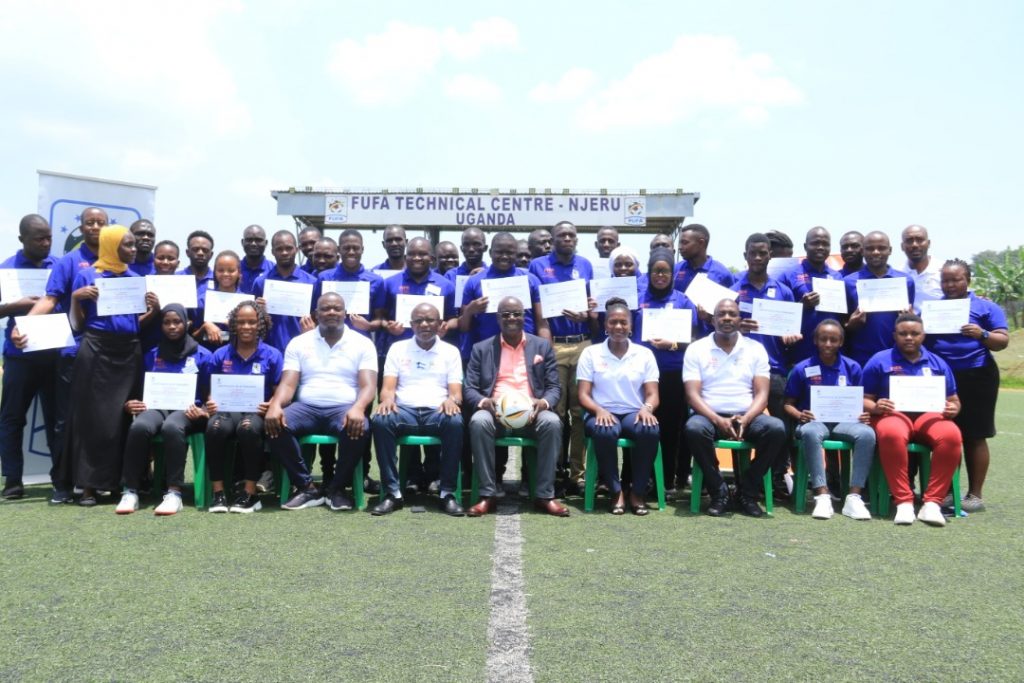
Courtesy photo: Participants pose for a group photo with their instructors and chief guest-Photos By FUFA Media

JINJA: Women’s football in Uganda has urguably grown in lips and bounds in terms of success on the pitch in the last seven years, but that can not be said of the streams of income to the game whose immediate challenges now remain poor packaging, marketing and visibility among others.

The game’s local governing body – Federation of Uganda Football Associations (FUFA) has ultimately made the initial step to providing a long lasting patch to these achilles of the women’s sport through capacity building, starting with journalists to champion the agenda.

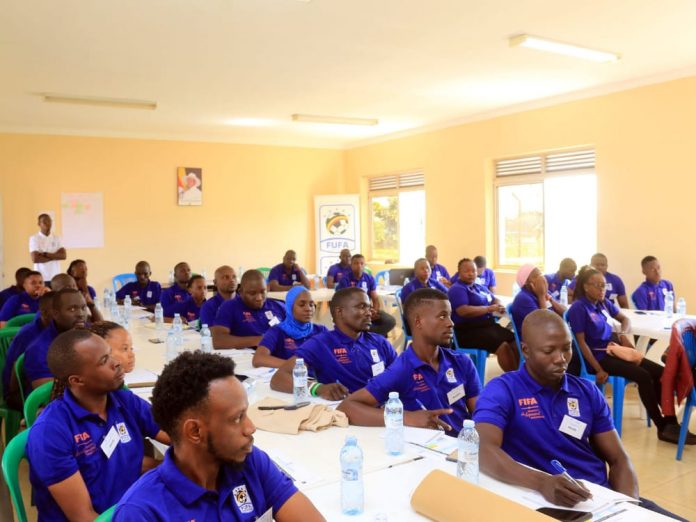
Thirty five media officers (at club level) and reporters from the mainstream media have undergone a three days training in the latest trends of communication and marketing of women’s football in a workshop that closed on Friday at Fufa Technical Center.

“I am impressed with the turn up, Most of the clubs have been represented, and a good number of journalists from a number of media houses have turned up as well. Participants are more than thirty and that is a good number for the start, and we hope to have another one next year as we continue our league development program.”- Fufa women’s football development officer Joan Namusisi said on Friday.

Participants came from different corners of the country and they were offered various modules including: communications in football, laws of the game, pre-match, match day and post match activities, marketing in football, importance and role of media officers, media relations, and club identity.

They were also tipped on digital media, safety and security, ambassador programme, marketing girls and women’s football, match day experience, introduction to match organisation and FUFA and its development programmes.

“All they have to do now is to go back and use the knowledge they have attained to ensure coverage of women’s football increase, and we promise to make a follow up to enable them do the job well,” Namusisi retorted.

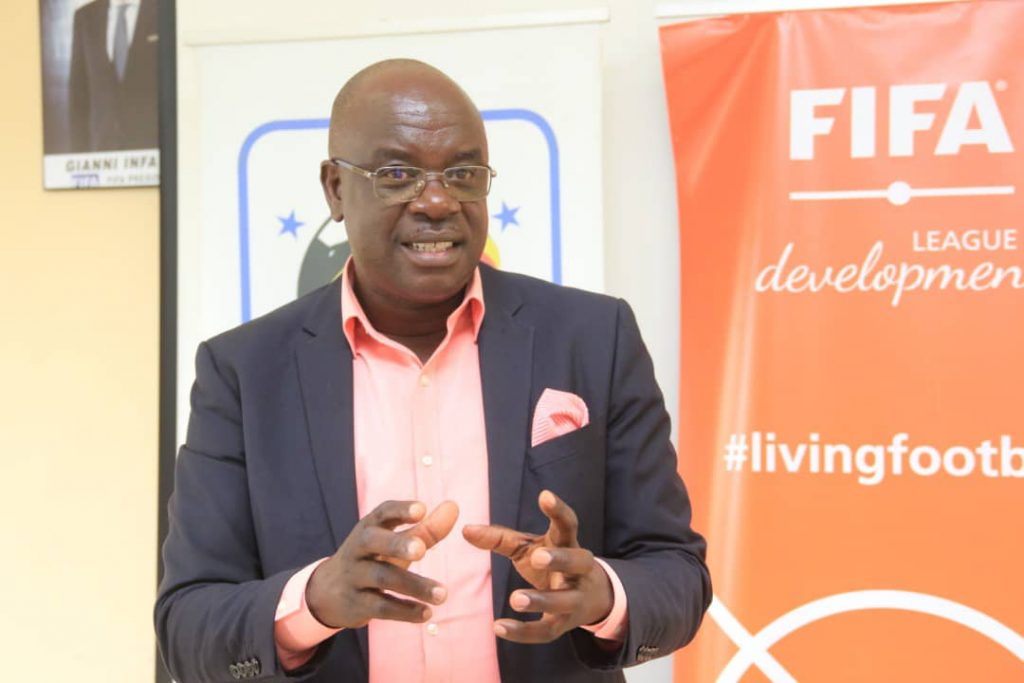
Her wishes rhymed well with Mr. Decolas Kiiza’s call to the participants. The Fufa executive committee member was one of the course instructors and he urged the participants to devote their efforts to improving the game.

“A student is a good as his teacher,” Kiiza said.

“Go out and do what you have been taught. If we continue to have what has been happening before this course, then we will have done nothing.”

“We have trained and expect you to use the knowledge you have learnt from here to enhance your own careers but most importantly, it should be used towards development of women’s football in Uganda.”

Mr. Rogers Mulindwa joined the closing function as the chief guest representing Fufa president Eng. Moses Magogo. His script did not sound any different from that of the former speakers as he also emphasized the need to transform what they have learnt into action.

Rogers Mulindwa Who Represented FUFA President

“I want to ask you to walk out of this hall and let people see a difference in you starting tomorrow. Let somebody see you doing things differently but in a better and positive way,” he said.

“The federation is committed to training and sharing information with the people so that we can have a wider family of football that is going to help us make our country not only better on the continent on field but also off the field.”

Several participants from different clubs voiced their satisfaction with the course content and positioned the federation top for praises.

“I have learnt that we can use prominent but credible people as ambassadors to promote our clubs and women’s football.During the course, I picked interest in safety and security as well and I thank Fufa and urge them to continue providing these courses so that even women can continue to learn football,” said Amatullah Nakazibwe, media officer at Isra Soccer Academy.

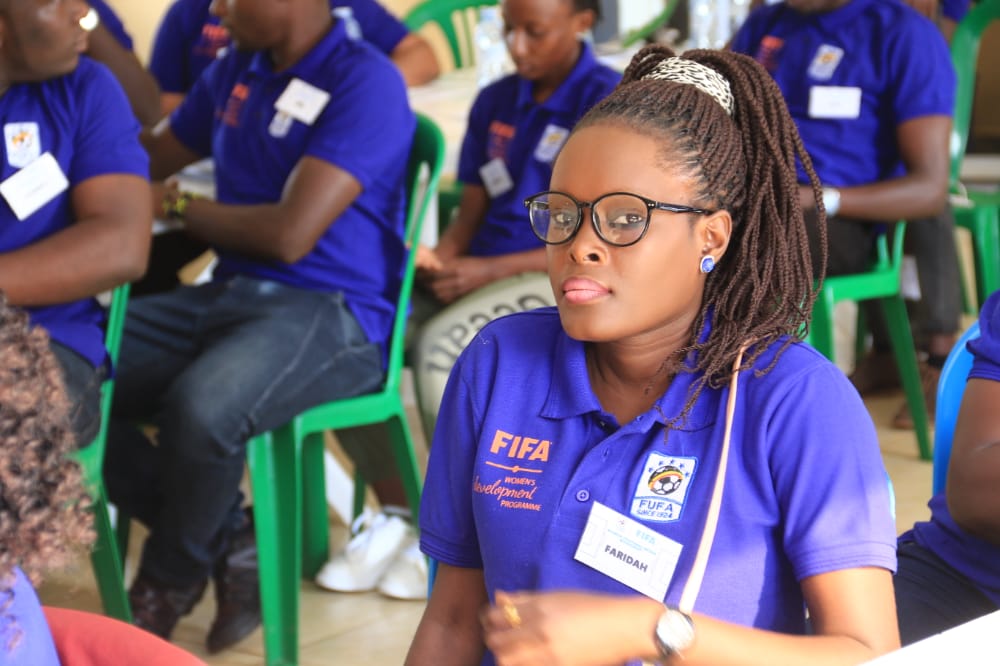
Faridah Tomusange Nassejje, the media officer of Kawempe Muslim Ladies said she understood every bit of branding.

“I have come to know more about creating a club brand that speaks for itself. Some of us have been thinking that branding is just a matter of color or a logo but after the three days here, I have come to know that it’s beyond that, and one of the main things a club has to treat with great consideration. We thank Fufa for this course and we promise we shall implement what we have learnt from here”- said Faridah

Faridah Tomusange At The Training- Photos By FUFA media

Full list of participants

Aminah Namutebi, Aminah Babirye, Margret Trexsoner, Gloria Nicole Apio, Amatullah Nakazibwe, Faridah Tomusange Nassejje, Priscilla Namikka, Jazirah Kansiime, Judith Tuhirirwe, Hamuza Waiswa, Ali Ssewanyana, Swaib Mbuga, Sinan Rajub Ssenoga, Hamza Ssali, Isma Mivule, Hambali Majojo, Andrew Talenga, Edwin Waiswa, Shafic Mutebi, Haba Plan Uwizera, Hassan Kirunda, Steven Mayanja, Godfrey Kakungulu, Yona Omara, Joshua Bachwa Abwoli, Abbey Munwyevu, Collins Arop Stanslas, Phillip Dexer Muhumuza, Banur Kintu, Issa Ssempijja, Samuel Ochora Oryem, John Baptist Opua, Godfrey Nsingwire, Onyango Gilbert,Gladys Zawedde.

Government Rolls Out New Plan For Refugees And Hosting Communities

0
Minister Charles Engola(second left) handing over copies of the plan to district teams during the launch in Gulu on Thursday

Cognizant of the unrest among refugees and their host communities, the Government has rolled out a new plan with redefined strategies to address the challenges.

The Minister of State for Labour, Employment and Industrial Relations, Col. (RTD) Okello Charles Engola Macodwogo, says the Jobs and Livelihoods Integrated Refugee Plan (JLIRP) will be the cornerstone for all interventions seeking to support refugees and their host communities.

“The plan is a response to the insurmountable livelihoods challenges faced by refugees and host communities in Uganda. It, therefore, proposes strategies of how to address these challenges to achieve a secure, self-reliant and resilient refugee and host communities in Uganda.” Engola noted.

He was speaking at the regional launches of the plan in Yumbe and Gulu districts, which climaxed in Gulu city on Thursday, October 6, 2022.

He cited the key challenges as: limited access to land; climate change; informalization of Medium and Small Enterprises, unemployment, weak coordination among partners, Gender Based Violence, the dwindling food ratios, declining donor support, and the effects of COVID 19 pandemic, among others.

He revealed that the Government of Uganda and its partners began developing the Jobs and Livelihoods Integrated Response Plan in 2018 and it officially got launched last year by the Prime Minister. He noted that the consultation process was inclusive and attracted various partners, the private sector and refugee hosting district local governments.

The plan has been developed for an integrated approach and is designed to  run for five years, from June 2020 – June 2025 in the refugee hosting districts including; Madi Okollo, Terego, Adjumani, Kikuube, Yumbe, Obongi, Kiryandongo, Kyegegwa,Isingiro, Lamwo, Kampala, Kamwenge, and Koboko.

The plan is being implemented by sector leads, namely: Ministry of Gender, Labour and Social Development; Ministry of East Africa Affairs; Uganda Business and Technical Examinations Board; Ministry of Education and Sports; Ministry of Agriculture, Animal Industry and Fisheries; Ministry of Trade, Industry and Cooperatives and Ministry of Local Government.

The Minister commended the financial and technical support received from International Agencies like UNDP, UNHCR, WFP, World Bank, FAO, ILO, EU, BMZ, DFID, CRRF, USAID, and GIZ in developing the plan.

The Assistant Commissioner for District Inspection in the Ministry of Local Government, Stephen Idha Koma, said the plan is aligned to NDP III and as such district councils should embrace it.

“Whoever comes to implement a program on refugees and livelihoods should ensure that they fit within this plan” he noted adding: “If we want to enjoy the peace and security created by our government we should engage in meaningful jobs and livelihoods. This will further sustain the peace.”

The Resident City Commissioner Gulu, Jane Frances Amongin Okili appreciated the plan saying it would help in synchronizing programmes for refugees and their hosts while ensuring that both benefit from the development interventions.

Uganda operates an open-door policy for refugees, which has seen over 1.5 million refugees hosted in different parts of the country. This also makes Uganda the African country with the highest number of refugees.