Friday, May 1, 2026
Home Blog Page 107

Karamoja Leaders Angered By Duplication Of Work By Ministries

0
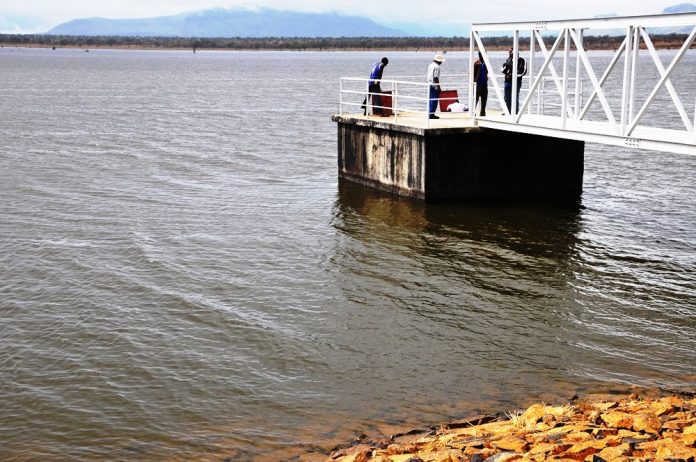
Arecek Dam In Napak Built By Government-PHOTO BY STEVEN ARIONG
????????????????????????????????????

By Steven Ariong

MOROTO: Leaders in Karamoja region in the north eastern Uganda have expressed their disappointment with the on going duplication of work between the two ministries of Agriculture and water in the region and asked the office of the prime minister to intervene.

The leaders raised this during the Kyoga water management meeting held at hotel Leslona in Moroto town early this week.

John Paul Kodet  the district chairperson Napak said the on going duplication of projects by the two ministries leaves residents in the region yearning for development.

FOR BEST WEBHOSTING, DESIGNS AND DOMAIN NAMES, CALL OR WHATSAPP +256758201313

According to Kodet in most cases where the ministry of water and environment engineers carry out design for dams, before they start construction of the dam, the ministry of Agriculture team goes to the same site and construct a valley tank.

“This is a serious issue which the office of the prime minister needs to help us to streamline because those confusions are affecting service delivery in the region,” Kodet said.

Paul Lokol the district chairperson Nabilatuk said developing Karamoja dose not need competition but working and walking together will change Karamoja.

“Sometimes we do wonder why the two line ministries compete, if one ministry has done with the design for the dam in one particular place, why cant another ministry go and do other projects,” said Lokol.

Moses Emudong a resident in Nakonyen village in Moroto district remembers when he escorted the ministry of water and environment engineers for dam sighting but after two weeks, ministry of Agriculture team also went to the same place and cleared the bush.

Emudong said they trust the work of the ministry of water and environment saying some of the projects the water ministry did are helping pastoralists in Karamoja.

“We have projects like Arecek dams in Napak, Kobebe dam in Moroto, Longoromit dam in Kaabong constructed by ministry of water and environment and they are helping people so why cant they allow the ministry of water and environment to handle dam construction and the ministry of Agriculture dose a component of irrigation,” Emudong asked.

Charles Muwonge the communication officer in the ministry of water and environment when contacted said he was out of office on sick leave while Ms Charlotte Kemigyisha the communication officer in the ministry of Agriculture could not pick up our repeated calls to give a comment.

If you have a story in your community or an opinion article, let’s publish it. Send us an email via editorial@accordconsults.com or WhatsApp +254797048150


Cross Boarder Trade Boosts Businesses In Moroto Town

0
Beer Trader At His Shop-PHOTO BY STEVEN ARIONG

By Steven Ariong

KARAMOJA: From late 1970s to 2007 Karamoja regions was a no gone zone because of the fight over cattle rustling no one wanted just to hear a ward Karamoja.

The insecurity had completely blocked the region from any development including   business until in 2001 when government launched disarmament exercise.

The successful disarmament opened up the region to the rest of the neighboring countries such as Kenya, Sudan and Ethiopia. Currently there is serious booming cross border trade of beer and other building materials in between Karimojong of Uganda and the Turkana of Kenya.

This website has learnt that over 70% of food that the Turkana people consume in Lodwar, the main town of Turkana county comes from Uganda via Moroto district.

Turkana traders prefer crossing to Uganda and buy all the food staffs, drinks and building materials in Moroto where they can only drive one hour which is a  distance of 140kilometers from Lodwar to  Moroto town compared to 8hours that they have been spending driving from Lodwar to Eldoret about 500 kilometers.

It should also be noted that Moroto district alone consumes up to 15,000 crates of beer in a week of which 11,000 creates are taken to Turkana in a week.

The most consumed brand is Nile Special, Tusker Lager and Guiness which the Moroto traders sell to Kenyan traders at shs 60,000 per a create. Tusker lager and Guiness is sold at shs3500  a bottle while, Nile Special and Bell lager is sold at shs 3,000 while eagle lager is sold at shs 2,000 a battle.

On daily basis more than 8 Kenyan Lories carry beer from Moroto to Kenya day and night without any attack. Mr. Patrick Lokol one of the traders dealing in selling beer  in Moroto said a day he sells  about 30 crates of beer that earns him some good money.

“Am very happy for the current peace because we are benefiting a lot from the cross border trade which we used not to do,” Lokol said.

Mr. Peter  Wambede a Uganda trader supplying vegetables to Turkana in Lodwar town said doing cross border businesses has helped him gain a lot including paying fees for his children.

He said at first the Kenya security officers used to disturb Uganda traders who cross with merchandise to Turkana extorting money but the county assembly authority of Kenya warned the Kenya security officials not to disturb Ugandan traders.

Mr. Mathew Lorukale a beer trader from Lodwar said the current peace has made them realized true business. He said they used counter loses while getting drinks and vegetables from Eldoret due to the current insecurity between the Turkana and the west Pokot herders.

“Traveling on the route from Lodwar to Eldoret it’s between death and live because your not assure of making a returned journey due to the ambushes,” Lorukale said.

Mr. Jeremiah Lomorukai the governor of Turkana county  said the cross border trade between Karamoja and Kenya would double when the two governments constructs the road that joins Uganda and Ethiopia vial Moroto, Lodwar in Kenya.

If you have a story in your community or an opinion article, let’s publish it. Send us an email via editorial@accordconsults.com or WhatsApp +254797048150
15 Unburied Bodies Of Dead Rustlers Scare Karimojong As They Flee Villages

0

Steven Ariong

Kaabong district authority is stuck with 15 dead bodies still littering at Kalotwe village in Lolelia sub county. The 15 Karimojong rustlers of Kotido district were gunned down on Wednesday night during a two hour clash with the UPDF soldiers.

The rustlers whose number still unknown had gone to raid animals in the kraal but they found the security well prepared for them. Mr.Jackson Moru one of the residents of Kalotwe village said the rustlers engaged the army for almost two hours.

He said although 15 were killed but others managed to drive away 50 heads of cattle towards Kotido district.

“This one of the deadliest fight between Karimojong and UPDF since the 3rd phase of disarmament was launched on 17th of July 2021,”he said.

FOR THE BEST WEBHOSTING, DESIGNS AND DOMAIN NAMES, CALL OR WHATSAPP +256758201313

Mr. Jino Meri the district chairperson said he was trying to mobilise for the wheel loarder  for collecting the bodies and bury them in a mass grave.

“Am looking for fuel to see how to use the wheel loarder to collect those bodies from the Kraal and bury them,” he said.

He noted that some families have already started migrating out of the place where the incident took place fearing dead bodies.

“You know in the Karimojong culture,a dead body is something so scary from them so they dont want to get associated with it,” he said.

Brig. Joseph Balikudembe the 3rd division commander confirmed the incident but didn’t tell how many rustlers or soldiers got injured.

He said one gun was recovered from the rustlers and called upon the leaders in Karamoja to play their role by discouraging the youth from carrying out criminality.

If you have a story in your community or an opinion article, let’s publish it. Send us an email via editorial@accordconsults.com or WhatsApp +254797048150

Army Concerned With More Illegal Guns Entering Karamoja

0
Some Of The illegeal Guns Paraded To The Media At Moroto Army Barracks- PHOTO BY STEVEN ARIONG

By Steven Ariong

KARAMOJA: The Uganda People’s Defense Forces commanders in Karamoja have revealed that rearmament was still going in Karamoja despite their massive operations against illegal  guns in the region.

This was revealed on Wednesday  by Second in command of the 3rd division of the army Brig Felix  Busizoori during a joint security  end of the year press conference in Moroto.

Brig Busizoori said during their launch of disarmament operation on 17th of July 2021, there expectation was to collect 500 guns estimated to be in the hands of the Karimojongs, but they have collected more than 500 guns  and they still collecting guns from the Karimojong an indication that there still many guns in the region.

FOR BEST WEBHOSTING, DESIGNS AND ALL DOMAIN NAMES, CALL OR WHATSAPP +256758201313

He said the  intelligence has discovered that although they keep on removing guns, but the rustlers also keep on rearming themselves with the help of Turkana pastoralists of Kenya and Toposa of South Sudan.

“We are now turning to deal vigorously with the porous borders of Karamoja, South Sudan and Kenya where these guns come from,” he said.


Joel Napakol one of the peace crusader in Moroto said government needs to go deep to understand why the appetite of a gun still in the mindset of the Karimojongs.

“The challenge I have with government is that, its focus is to remove a gun, but not to understand why the Karimojongs are not about to give up with acquiring guns,” he said.

Some Of The illegeal Guns Paraded To The Media At Moroto Army Barracks- PHOTO BY STEVEN ARIONG

Moris Nangiro another peace actor appealed to government  to fulfill some of the pledges they made to the armed rustlers who handed over their guns.

“To me government is also not honest to honor its pledges, because the rustlers who handed over their guns had expected to be supported by government as it had promised but up to now nothing has been done and what do you think that idle man can do,” he asked.

Grace Nachap a resident of Campswahil juu in Moroto Municipality said government needs to introduce entrepreneurship skills for the reformed rustlers so that they minds are occupied.

If you have a story in your community or an opinion article, let’s publish it. Send us an email via editorial@accordconsults.com or WhatsApp +254797048150

Moroto Municipality Beautifies Town Ahead Of Christmas To Woo Visitors

0
Moroto Resort Hotel- PHOTO BY STEVEN ARIONG

By Steven Ariong
MOROTO: Whoever had traveled from any part of the country to Moroto district in Karamoja sub region and spent a night in Moroto Municipality in may be six years back and still have the same picture of what he saw in Moroto municipality should now forget of that picture, the Municipality has moved very far from the old picture from what someone might have seen it.

In 1997 to 2010, the municipality image was indeed bad with a lot of human waste scattered every corner with a lot of bad smell, the so called Municipality had only two streets include: Lia and Kitale streets with no streets lights, the buildings in the municipality were also dilapidated with about 99% of it was mad and  wattle houses
without running piped water.

FOR BEST WEBHOSTING, DESIGNS AND DOMAIN NAMES, CALL OR WHATSAPP +256758201313

People running businesses in Moroto municipality were using lamplights in the shops and houses although there was a thermal generator which could supply power in the municipality but the municipality could remain in darkness because the generator was supplying power only up to midnight for a limited period of time.

But now whoever still has in mind what he or she might have seen in Moroto Municipality in 1997 or 2010 should now forget and know that the town is now a clean town with a lot of development changes taking place.

New changes in Moroto municipality have made the Moroto town to be a destination for tourist attraction in the entire Karamoja region.

The municipality has been connected to the national grid electric power and has electricity 24hrs with a lot of music sound which has replaced the gun sound unlike those days before disarmament.

With now few days left to the Christmas holiday, many people have made advance plans on making the best out of the holiday and Moroto can be one of the places.

For those in other countries in the East African continent who have never reached to Moroto, the town in located in North Eastern Uganda lying west of Mt Moroto and north of the Kenya Republic. It is the main town of Moroto district and the district headquarters are located there. The district was named after the town.

Moroto is located approximately 210 kilometers (130 mi), by road, northeast of Mbale, the nearest large city. and lies approximately 420 kilometers (260 mi), by road, northeast of  Kampala, the capital city of f Uganda and the largest city in that country.

The coordinates of the town are: 2°31’48.0″N, 34°40’12.0″E (Latitude: 2.5300; Longitude: 34.6700).

It was initially big and seveni districts in Karamoja were caved from  these include Napak, Nakapiripirit, Kotido, Amudat, Abim and Kaabong in the northeastern Uganda.

This town has unique things that can feed the eyes of a visitor whose first time to step in Moroto, some of this sites including beautiful geographical areas with plenty of mountains, types of hotels and decent accommodation and art and crafts.

The town has a friendly environment that would make tourists to enjoy
spending their Christmas holiday in Moroto.

Apart from having unique things, Moroto town has also various tourist attractions including the only museum in Karamoja region that inhabits and tells the story of Karimojong culture and heritage.

No worry of accommodation, the town has enough accommodation with
hotels like  Moroto Resort hotel which is just now opening up, Yellow stone hotel, Mt. Moroto hotel, Hotel Africana, Seven ranges, Hotel strikers, City friend, hotel Leslona.

Others include Rapona, Lavender Inn and many other hotels in the town yet it used to have only three hotels in the whole Municipality in the last five years.

Moroto Resort Hotel- PHOTO BY STEVEN ARIONG

A survey carried out by this website  shows that Moroto Municipality currently has about 13 operational streets some with street lights while others are still being worked on, it also has running piped water which was not their since the colonial time yet Moroto Municipality is among the colonial Municipalities in the country.

As a result of changes in the Municipality, it has drowned the attention of Kenyan officials including ministers, governors and senators who always cross to Moroto to spend the weekend and move back on Sunday to resume their office work every week.

Speaking to the media Mr. Steven Okurut the Moroto Municipal town clerk attributed the current changes that the Municipality is going through to the peace in the region after successful disarmament program and hard work among the municipality staffs and the district.

“The changes that you’re seeing today in Moroto Municipality are caused by collective efforts both from the district and the Municipality and I want assure the public outside Karamoja that in the next five years Moroto will be stable and competing with other Municipalities in cleanness,” he said.

Mr. Simail Mohamed the mayor of Moroto Municipality cautioned people investing into housing estate to start thinking of building storied  houses adding that in the few years to come the Municipality will demolish all the houses that are not storied.

“We are moving towards city status in 2025 so people building houses especially on the high way must build storied houses to avoid being disturbed by the city,” he said.

If you have a story in your community or an opinion article, let’s publish it. Send us an email via editorial@accordconsults.com or WhatsApp +254797048150

“Messi Is a Superstar”- Says Germany’s Matthäus

0
FILED - German World Cup ambassador and former national player Lothar Matthaeus is pictured ahead of the FIFA World Cup Qatar 2022 Quarter-Final soccer match between Croatia and Brazil at the Education City Stadium in Al Rayyan. Photo: Robert Michael/dpa

BY DPA

Former Germany captain Lothar Matthäus has hailed Lionel Messi and is far from disappointed that the Argentine great bettered his World Cup appearance record in the Qatar final en route to winning the trophy for the first time.

Matthäus played 25 World Cup matches highlighted by the 1990 title Germany won against Diego Maradona’s Argentina. Messi moved one ahead of Matthäus with 26 games on Sunday in the dramatic penalty shoot-out triumph over France.

CALL OR WHATSAPP +256758201313 FOR THE BEST WEBHOSTING, DESIGNS AND ALL DOMAIN NAMES

“What a player! What a superstar! How he led this team to the title at the age of 35 can hardly be put into words,” Matthäus said in praise of Messi in his column for Sky TV.

“If anything was needed to make him immortal to his fans, he has now achieved it. We can be happy and grateful to have experienced him and to continue to admire him.

Matthäus did not want to be drawn into a debate whether Messi was now also the greatest player ever as he said: “Messi is certainly the best of this millennium and one of the greatest athletes we have ever seen.

“The fact that he broke my World Cup appearance record on the side is as much to his credit as anything else.”

Matthäus said Argentina were deserved champions because they were “the best team in this great tournament” and that he was happy for the football-mad country.

Messi has said that his fifth World Cup in Qatar would be his last but Matthäus said he wouldn’t be surprised if Messi featured at the next edition 2026 in the United States, Mexico and Canada.

“I am not so sure that this was his last World Cup,” Matthäus said

If you have a story in your community or an opinion article, let’s publish it. Send us an email via editorial@accordconsults.com or WhatsApp +254797048150

German Returns Nigeria’s Artefacts Looted During Colonial Era

0
Alhaji Lai Mohammed (R), Nigeria's Minister of Information and Culture, holds the miniature ivory mask from Stuttgart, while German Foreign Minister Annalena Baerbock (L), and Nigerian Foreign Minister Geoffrey Onyeama, stand behind him, at the Nigerian Foreign Ministry in Abuja. Photo: Annette Riedl/dpa

By DPA

German officials returned 20 of the treasured Benin Bronzes on Tuesday in the Nigerian capital Abuja, a move that has attracted international attention amid a debate about returning art looted in the colonial era.

The valuable objects were handed over to Nigeria in a solemn ceremony with German Foreign Minister Annalena Baerbock and Culture Minister Claudia Roth.

“It was wrong to steal these bronzes. It was wrong to keep these bronzes. And it is more than overdue for these bronzes to be returned to their homeland,” Baerbock said after a meeting with her Nigerian counterpart, Geoffrey Onyeama, earlier on Tuesday.

“Nigeria, Africa and indeed all of humanity will remember and always cherish the period in human history when Germany stood by us,” Nigeria’s Minister of Information and Culture, Alhaji Lai Mohammed, said after the ceremony.

CALL OR WHATSAPP +256758201313 FOR BEST WEBHOSTING, WEB DESIGNS AND ALL DOMAIN NAMES

Twenty or even 10 years ago nobody could have anticipated the return of the works, “because the obstacles to achieve repatriation were seemingly insurmountable,” Lai Mohammed said.

The treasures – looted by colonial powers in the 19th century – previously belonged to collections of museums in Berlin, Hamburg, Cologne, Dresden, Leipzig and Stuttgart.

“This is a story of European colonialism,” in which Germany played “a dark role, causing tremendous suffering in different parts of Africa,” Baerbock said.

The return of the bronzes is “a crucial step towards addressing this chapter in the way that it should be addressed: openly, frankly, with the willingness to critically assess one’s own actions.”

The Green Party politicians were accompanied on their visit by the heads of several museums.

More than 1,100 of the works from the palace of the then kingdom of Benin, which is now part of Nigeria, have so far been in the possession of around 20 German museums. The objects, which are made of ivory and other materials in addition to bronze, mostly come from British looting in 1897.

The five museums now involved and their sponsors had already transferred the ownership rights to all Benin Bronzes prior to the returns. At the same time, the two sides agreed that Germany may keep some of the art treasures out on loan for display in Germany.

“It’s rightfully ours and should be where it belongs, which is here, but nevertheless, we will share it with the world because for us, it is a common human asset,” Foreign Minister Onyeama said.

Nigeria called on other organizations, institutions, museums and private collectors still holding on to Nigerian antiquities to release them.

Lai Mohammed mentioned the British Museum in particular.

“Many of these cultural objects are not mere art to us, but the true essence of our being. These artefacts are not mere the collective works, but our culture and heritage. They belong here and not anywhere else,” Lai Mohammed said.

If you have a story in your community or an opinion article, let’s publish it. Send us an email via editorial@accordconsults.com or WhatsApp +254797048150
CRAZY AND INTESTINGLY WIERD: What Netizens Betted Before The Argentina Vs France Game

0

It still making headlines how Argentina who convincingly beat France 2-0 in the first half ended up conceding more two goals courtesy of speed merchant Kylian Mbappe forcing an extra time that also ended 3-3 with a Kylian Mbappe goal and a Messi goal in extra time.

In the penalty spots, Argentina netted 3 again France one penalty spot netted by Kylian Mbappe still and Messi took the trophy home bringing the debate of the Greatest Of All Time Player (GOAT) debate to an end.

FOR BEST WEBHOSTING, WEB DESIGNS AND DOMAIN NAMES CALL OR WHATSAPP +256758201313

However, some netizens made weird bets and vowed to do certain things incase their team (France or Argentina won) the world cup trophy as a sign of support and some of those who lost have started doing what was in their bed. We bring you some of these crazy, wierd and interesting things netizens vowed to do.

These and many other things people vowed to do if their team either France or Argentina won the world cup but the debate settled well on Sunday when Argentina took the trophy home.

If you have a story in your community or an opinion article, let’s publish it. Send us an email via editorial@accordconsults.com or WhatsApp +254797048150


OWEYEGHA-AFUNADUULA: On Makerere University Becoming a Cross- Discipline And Trans-disciple Institution For Knowledge Re-integration

0
Makerere University Ivory Tower

CAN MAKERERE UNIVERSITY BECOME A CROSS-DISCIPLINE AND TRANS-DISCIPLINE UNIVERSITY FOR KNOWLEDGE RE-INTEGRATION?

By Oweyegha-Afunaduula

Center for Critical Thinking and Alternative Analysis (CCAA) Seeta, Kampala, Uganda.

Not long ago I wrote an article titled “Does Intellectual Capital Matter”? While it was an article of great public interest, I wanted to specifically target our universities, which were squeezing intellectualism out of their body politic, and stressing academicism and scholasticism.

My concern was that the universities were concentrating on expanding student numbers, with the approval of the Ministry of Education, and producing graduates at all levels of the education institution with diminishing capacity for intellectual inquiry, questioning, critical thinking.

When both intellectual and critical thinking enterprises of universities fall, even the capacity and quality of the academic enterprise also fall. The tendency is for the universities to concentrate on producing numbers rather than quality of graduates.

In the past, universities enhanced their relevance by so many of its teachers and learners engaging in intellectual discourses and clashes publicly and internally. This helped minds either to diverge or meet on issues of human concern, or else produce enough contradiction that would enable people to innovate new theories and suggestions for the way forward.

Unfortunately, universities seem to have relapsed into centres of stagnancy. Academics now just write for themselves and their students, without offering themselves for scrutiny outside their academia.

They assess each other, reward each other and grow in mental capabilities and careerism while falling far below standard in intellectual capacities. Academicism and scholasticism are, the exclusive preoccupation Makerere University and other Universities in Uganda.

Extracurricular activities, which used to make the university a more dynamic and connected entity internally and externally are less emphasized than in the past. Theory has outstripped practice as well. This is disadvantaging learners, especially in the employment markets, and excluding teachers from the wider marketplace of ideas.

We can blame the overemphasis on academic knowledge production, transmission and acquisition for career growth and development in small pockets of knowledge and practice called disciplines.

The knowledge culture of disciplines allows the creation of small pockets of knowledge in which knowledge workers specialize, or overspecialize, and regard themselves as knowledgeable.

Their products clog every institution of government and the private sector but they cannot perform as integrated units or integrate anything. They were not produced to do so. When politicians talk of integration they have no integration agents to help them actualize the idea.

Elsewhere outside Africa, universities are training for the 21st century workforce -integrated and dynamic to exploit the opportunities created by the cyberage, which requires greater freedom of thought, interaction and practice. The worldwide trend in education is thus re-emphasis of reintegration of knowledge, innovation and creativity.

It is recognized and accepted that it is no longer fashionable to fragment knowledge and knowledge production, confining knowledge workers and seekers in small knowledge cocoons (disciplines), with almost no interaction with others in different knowledge cocoons, who only interact casually with others outside their knowledge cocoons.

The process of de-emphasizing disciplines has been on especially since the very early 1970s, but universities, especially in Africa, have been conducting their knowledge work as if the process has not started. They have ignored it at the expense of their learners.

According to Manville, cited by Peters (1992), knowledge development is a professional responsibility putting people in touch with one another, linking minds. It is no longer a casual, personal process to earn personal credit, but is becoming more systematized, and the overall knowledge-building process will allow people to extend their personal networks fast and efficiently – outside cocoons of knowledge.

This, however, can only happen meaningfully if apart from liberalizing the economy without liberalizing politics, there is a parallel process of liberalizing of knowledge. To allow greater freedom and democratic practice of and among knowledge workers and their learners.

Liberalization of knowledge entails dissolving the rigid walls of knowledge cocoons to allow the emergence of new integrating and integrative cultures of knowledge, namely: interdisciplinarity, transdisciplinarity crossdisciplinarity and non-disciplinarity. Interdisciplinarity involves Integrating knowledge and methods from different disciplines using a real synthesis of approaches.

Crossdisciplinarity involves viewing one discipline from the perspective of another.  Transdisciplinarity involves creating a unity of intellectual frameworks beyond one discipline. Nondisciplinarity is a knowledge discourse, which does not evoke or involve recourse to disciplines of knowledge.

We can as well refer to nondisciplinarity as the most advanced extradsciplinary knowledge integration culture in the sense that it is free from disciplinary limitations. Cultures and traditions throughout the world remain essentially nondisciplinary, but they are being polluted by products of disciplinary knowledge and their practices.

The question is: Can Makerere University, and other newer universities, which imitated its knowledge practices, open up to the new cultures of knowledge? The answer is “Yes” they can. The challenge is that in virtually all the universities there is currently no cadre of scholars to sow the mustard seed of knowledge reintegration in the 21st century. Yet this is happening in other great universities of the World.

In Africa South of the Sahara only Mbarara University of Science and Technology (MUST) took serious note of the process of reintegration of knowledge sweeping the globe and started to de-emphasize imprisonment of scholars in disciplines. It has a Faculty of Interdisciplinary Studies.

However, it has yet to open up to the other integrative cultures of knowledge. Makerere university more or less rejected interdisciplinary knowledge production and research in the early millennium, preferring to re-entrench disciplinary knowledge production and research even more than was the case in the 20th Century.

All its academic and administrative leaders appear insensitive to the current knowledge re-integration wave sweeping the globe.  However, even if they were they would be limited by the rigid disciplinary structure and function of the university.

Thus we talk of tribes in human society, especially in Africa, but there are also academic tribes in universities. We talk of ethnocentrisms in human society, but there are also ethnocentrisms in the academic world. However, in the history of knowledge, local knowledge everywhere on the globe was one and integrated.

It still is, with just dimensions as many as those of the human brain. Also, the knowledge of ancient philosophers in many human societies was similarly shaped as one and integrated. It aimed at producing generations of people with integrated minds. However, as time went on, creation of knowledge empires (academic empires) led to the emergence of both broad categories of knowledge (Natural Science, Arts or Humanities and Social Science, which constituted one science with just three dimensions -Natural science, Humanities or Arts and Social Science).

Within each category of knowledge, numerous disciplines with rigid walls around each of them, were created and continue to be created. Within each discipline, knowledge is produced, transmitted and acquired unlinked to other knowledges. Experts in each discipline arise linked by ideas within each discipline but not ideas in other disciplines.

Creation of academic tribes, forever intensifying narrow academic specializations, explains the rising multiple disciplines (multidisciplinarity), which does not challenge disciplinarity, but only reduces the distance between them, without allowing interaction and integration. Even when scholars write joint books or reports, they will write separate chapters and separate conclusions.

They may not even interact during the writing of the book, leaving the editor to do the rest of the work. Even if people from different disciplines work together, they do not influence each other in any significant way.

This brought a lot of credit to the institution that employed such knowledge workers and a lot of esteem to them. It still does in the institution, which is resisting change in the 21st century. Multidisciplinarity does not integrate academia.

Multidisciplinarity may have been useful in the past, particularly in the 20th Century university, when employability of disciplinarily-produced graduates was assured. However, today it is counterproductive in a century of new knowledge production in new knowledge cultures of interdisciplinarity, crossdisciplinarity, transdisciplinarity and nondisciplinarity.

Disciplinarily produced graduates may still be employed in and outside universities but their fortunes are falling meteorically in the labour market. Unfortunately, education designers and managers at the national levels, especially in Africa, continue designing and managing curricula the same way as was the case in the 20th Century. That is designing and managing education backwards, yet the cyberage, which has taken us by storm, requires that we change quickly.

I must stress. There is a new marketplace of ideas unknown to scholars imprisoned in disciplinary cocoons of knowledge and practice. That is imposed ignorance, which nonetheless we boast of and continue to glorify and reward highly. If there are some scholars that would like to be part of the wave of knowledge reintegration, they are not free to do so because they are imprisoned in the disciplines, where they must pursue their careerism.

We can say with confidence that disciplines are not only prisons, but they simultaneously violate the freedoms and democratic rights of the knowledge workers and learners. They cannot easily think outside the box or use ideas created outside the box, create and innovate beyond the individual free of manipulation by higher order authorities.

It is true it can be a challenge to evaluate work outside the boundaries of disciplines within the academia. Such work does not easily fit into the models within which academics have traditionally been promoted. Indeed, the quality of the work is not trusted by the people prepared disciplinarily.

The critical thing is to develop working relationships between knowledge workers in different disciplines. Different disciplines have different practices and to understand the practices of different disciplines can be painstaking. One may not even develop interest in the practices of other knowledge workers in the other disciplines after being trained for decades to do things differently.

However, if trust and confidence can be molded between the knowledge workers of different disciplines and overlapping motivations emerge, the knowledge workers can get interested, become immensely engaged and happy working, thinking, reasoning, writing and allowing their minds to meet across disciplinary cleavage lines.

If things go well between the knowledge workers, they can include all their students in the class as co-learners, co-designers, co-innovators, co-researchers and co-evaluators of the learning enterprise.

Every knowledge worker, knowledge leader and knowledge manager should know that there is a quest to improve the learning experience and produce more wholesome learners who can cope with a century of accelerating changes ahead; who value holistic approach to education and life; and who can venture into the market place of ideas without fear or favour.

We have no alternative but to go forward in the 21st century. We have to prepare students or learners for the 21st century workforce, which is distancing itself from the 20th century that was artificially disciplinary in knowledge production, transmission and acquisition.

Interdisciplinarity, crossdisciplinarity, transdisciplinarity and non-disciplinarity collectively constitute the new team science, which is making knowledge workers, students and practitioners elsewhere fit in the cyberage dominated by nondisciplinary teamwork practice. We can accordingly classify science into four categories: interdisciplinary science, crossdisciplinary science, transdisciplinary science and nondisciplinary science.

We can also talk of these sciences as “the knowledge reintegration sciences” of the 21st Century and beyond. As such, everyone fits in quest for reintegration locally, nationally, regionally and globally. ,It is a new science literacy for integration to produce a new cadre of graduates with integrated minds that can meaningfully contribute to integration of the world at all levels.

Reintegration of knowledge improves the quality of graduates and their employability and creates a new cadre of knowledge workers who are not arrogant and will not fear to work in teams. It values local knowledge of the indigenous people. Meaningful collaborative teamwork for a more holistic, interconnected world in which everyone and everything matters is the ultimate goal of education using these sciences, not as aliens but integral to it.

Besides, if universities embrace knowledge reintegration, they will not fall prey to adroit politicians who want to disconnect the sciences (Humanities or Arts, Social Science and Natural Science). They will resist being misled to create unnecessary divisions between and within the academia by people who want to gain politically from the divisions.

The new knowledge workers must work to reunite the sciences as one science by first embracing reintegration of knowledge as an imperative for the 21st Century. However, institutions must now restructure and redesign themselves for reintegration.

Only this way shall we begin to produce graduates that can serve humanity in various capacities for integration in all spheres of human life – economic, political, social, ecological, environmental, etc. – towards a more holistic world.

Later will be too late. Future generations will blame us for having been so ignorant as to value disconnection of knowledge and practice. We must look back to the future, which is already here.

Can Makerere University simultaneously open up to and restructure itself for interdisciplinary, cross-disciplinary, transdisciplinary and nondisciplinary education and research even if it failed to open up to interdisciplinary education and research in the early millennium? I think and believe it can if its knowledge workers and academic and administrative leaders realize that they are preventing the university from being a 21st Century university.

Interdisciplinarity, crossdisciplinarity and transdisciplinarity and nondisciplinarity can coexist in the university and cross fertilize each other in an academic environment liberated for knowledge re-integration.

Behind every problem is the problem of leadership. The problem here is that the new cultures of knowledge re-integration is sweeping the world but knowledge workers and academic leaders have been resisting it since the early millennium in the fashion of “The Devil You Know is Better Than the Angel You Don’t Know”.

Interdisciplinarity (or interdisciplinary science)

“Interdisciplinary teaching and learning” is exactly what it sounds like: students combine learning from multiple disciplines to come up with new ways to think about issues and solve problems. Teachers looking to create these opportunities for students might ask, what is an interdisciplinary approach? Compared to traditional approaches, an interdisciplinary approach expands what students learn by allowing them to tackle problems that don’t fit neatly into one subject.

It also changes how students learn by asking them to synthesize multiple perspectives, instead of taking what they’re told by a teacher at face value. In the public realm graduates interdisciplinarity produced can discuss different issues from different angles without disciplinary limitations.

They can also write and intellectualize on issues that do not respect disciplinary orientations and walls. This way they are superior to their rigidly disciplinary colleagues. We must not postpone interdisciplinary capacity building in our universities if we are to be part of the international education system.

Since the current Makerere University scholars and academic leaders were, at the beginning of the new millennium, introduced to interdisciplinarity, and the University Council went ahead to approve a policy for interdisciplinary education and research without putting it at per with disciplinarity in terms of career development, preferring disciplinary career development, it should not be so difficult to rethink the University’s collective attitude towards interdisciplinary teaching and learning.

It would be a matter of rethinking the Akiiki Mujaju academic policy of the early millennium, which devalued interdisciplinary education and research, casting them as inferior to disciplinary education and research.

It is, however, probably true that the vast majority of scholars have not heard of crossdisciplinarity, transdisciplinarity and nondisciplinarity because the strong disciplinary structure and function of the university occluded them from the university’s knowledge culture.

Yet they, with interdisciplinarity, are the teaching and learning knowledge cultures of the 21st Century and promise to be so beyond the century because, as I said, we are in the cyberage which has no respect for the disciplines and their rigid walls.

Let me briefly introduce these other cultures of knowledge production, acquisition and transfer.

Transdisciplinarity (or transdisciplinary science)

Transdisciplinarity involves creating a unity of intellectual frameworks beyond one discipline. However, Ttransdisciplinarity is generally defined by the inclusion of non-academic stakeholders in the process of knowledge production. It is a promising science, but its ability to efficiently address the world’s most pressing issues still requires improvement.

As knowledge reintegration guru, J. Thompson Klein, wrote in her 2015 paper “Reprint of “Discourses of transdisciplinarity: Looking back to the future”, citing Jean Piaget and E. Jantsch (1972), “The three discourses of transdisciplinarity are transcendence, problem solving and transgression.

In short, while the transcendence discourse seeks to produce a general theory of science and systems, the problem-solving discourse puts strong emphasis on social purpose. The third discourse, entitled transgression, serves the rhetoric of critiquing and reformulating the status quo imposed by dominant assumptions in scientific generation”.

Klein explains that the discourse of transcendence has included holistic approaches aimed at reorganizing the structure of knowledge towards unity (i.e., a universal scientific explanation). Some examples include systems theory, policy sciences, philosophy, and unification theories in physics.

The discourse of problem solving takes a pragmatic approach to address social missions by integrating knowledge and skills from all disciplines in large-scale projects and processes. Coproduction of knowledge with stakeholders in society is an obvious tenet in this discourse with the aim of solving complex problems that originate in society.

Accordingly, an education model based on feedback between academic and non-academic system designers and innovators that leads to new categories of methods and tools forms the vision of transdisciplinarity. Transgression, the third discourse, as Klein explains, “moves beyond instrumental integration” as it concentrates on scientific and systems uncertainties and high decision stakes.

By renouncing of disciplinary truth claims, this discourse is related with the concept of knowledge production in which a “new social distribution of knowledge” occurs due to contributions from wider range of organizations and stakeholders in producing “socially robust knowledge”.

This approach transgresses the expert/lay dichotomy and therefore leads to new partnerships between academe and society. Just as I suggested for interdisciplinarity, we must not postpone transdisciplinary capacity building to complement the strongly disciplinary academic culture.

Crossdisciplinarity (or crossdisciplinary science)

Crossdisciplinarity may be looked at as a research attitude exemplified by a tendency to frame research strategies and insights through the lens of a single academic attitude or domain, but tempered by an openness to complementary strategies and insights from other perspectives.

The benefits of cross-disciplinary teaching, learning and research are widely acknowledged. Crossdisciplinary science links teaching, learning and research with innovation, creative problem-solving, new meanings and the ability to advance knowledge with intellectual breakthroughs.

The benefits of cross-disciplinary research come from being attentive to ideas and processes developed in diverse knowledge and practice fields in an endeavour to find new meaning using fresh perspectives. It is very helpful in tackling what are called wicked problems with both scientific and societal significance. There is need to build capacity for cross disciplinarity.

Nondisciplinarity (or nondisciplinary science)

Nondisciplinarity is knowledge discourse, which does not evoke or involve recourse to disciplines of knowledge. We can as well refer to it as the most advanced extradsciplinary knowledge integration culture in the sense that it is free from disciplinary limitations. Cultures and traditions throughout the world remained nondisciplinary.

They still do. Indigenous knowledge is thus nondisciplinary. Even during the times of the great ancient thinkers such as Socrates, Plato and Aristotle, knowledge production was nondisciplinary because until Aristotle introduced them disciplines did not exist.

With the creation of disciplinary knowledge production entities in the academia nondisciplinarity was occluded. If one was nondisciplinary, one did not belong to the world of knowledge.

Fortunately, in the evolving knowledge society, nondisciplinarity is repenetrating the world of knowledge with many networks, which have no respect for disciplines, being created between society, government, industry and academia.

Environment is better studied and conserved non-disciplinarily especially because it is a social and cultural issue, and in the past, it was conserved and managed socially and culturally. The social media are a modern example on nondisciplinarity on the move again.

For God and My Country.

The Writer Is a Ugandan Scientist And Environmentalist

DISCLAIMER: The views expressed in this article are solely for and belong to the author/ writer. They don’t reflect, portray or represent Accord Communications Limited, it’s affiliates, owners or employees. If you have a story in your community or an opinion article, let’s publish it. Send us an email via editorial@accordconsults.com or WhatsApp +254797048150

Uncompleted Shs140bn World Bank Funded Projects In Karamoja Anger Leaders

0
One Of The Valley Dams- COURTSEY PHOTO

By Steven Ariong

KARAMOJA: Leaders in Karamoja region have demanded for special investigations into uncompleted projects funded by World Bank through Ministry of Agriculture and animals industry under Resilience projects in the region.

Some of the  projects such as dams and animal holding grounds and cattle markets which were  fully funded and expected to have been completed since 2019 when the projects  were launched have remained uncompleted while other sites have been deserted by the contractors over unknown reasons.

Some of the projects visited such as Morungole dam located in Kaabong district which was under construction by Zhongaho company limited a Chinese firm at the cost of shs7.8 billion, the work has since stalled and site deserted after it was launched in May 2019.

Mr.Joshua Bosomtwe the site manager of Zhonghao when contacted to ask why they left the site declined to comment.

“Am not in position to talk about that may be you talk to the director,”he said and hanged up his call.

Mr. Jino Meri the district chairperson of Kaabong district said many projects under world bank have failed to create an impact to the lives of the people of Kaabong and Karamoja at Large.

“Look at that project of Morungole, not even the district was involved because this is the ministry of Agriculture error where by they don’t want to involve the district in monitoring the projects,” he said when speaking to our reporter.

Another dam visited   in Kanapidi, Kaoyaagor village in Kotido district which costed government shs6.7billion has also stalled before it’s completion since it was launched in April 2019 and expected to be done within  five months,  although there was sign of works going on but their was no body at the site not even the equipment by the time we visited.

Mr. Joseph Komol the district Chairperson of Kotido district said the work which was taking place at the dam by the ministry of Agriculture team was like not that impressive.

Kamol further says he only learnt about the construction works in the dam around November 2021 yet the work was officially launched around April 2021 and it was expected to have only taken six month period but till now work has not been completed.

“We went to the site as council but we never got any one at the site but if you see what’s in the site honestly it’s not a dam worth shs6.7billion,”he said.

Another dam which has also stalled is Kosike in Amudat district which costed government shs10bn no work is in progress since.

It should also be understood that the animal holding ground in Namalu visited by our snoops has installed and the cattle market in Lemusui sub county in Nakapiripirit district was been abandoned long time ago.

Mr.Paul  Lokol the district chairperson of Nabilatuk district said  behaviors of ministry of water and environment and ministry of Agriculture staffs affects the development of Karamoja.

“The MAAIF people just do their work without involving the district people not even the local community and this makes it hard for proper supervison and owning any project,”he said.

According to Mr.Lokol  as long as the technical team from the ministry of water and ministry of Agriculture continue to behave as if they are from heaven, there will be no sucesful projects under world bank in Karamoja.

Mr.John Nangiro the district Chairperson of Nakapiripirit district said the ministry of Agriculture has failed to complete a cattle market located in Moruita sub county in Nakapiripirit district which costed them shs 500million and another cattle holding ground in Namalu which costed government shs 1.8billion all remain uncompleted.

“All the sites have been abandoned by the contractor and no one in the ministry of Agriculture is bothered to follow up,” he said.

He said he has written several letters to the line ministry for the delayed completion of Resilience projects but all is vain.

“We are looking ways to meet with the team from the world bank to express our disapointment over their funded projects,”he said.

According to Mr.Nangiro, projects of more than 140 billion under Resilience program in Karamoja have failed.

But MAAIF Engineer who over sees the projects in the region Mr.Francis Wanaloba when contacted acknowledged some projects have delayed due to what he calls unavoidable circumstances such as rains and Insecurity.

He gave an example of Morungole dam where the Chinese contractor abandoned the site after being attacked by the armed cattle rustlers.

He said they were working with the contractors to ensure that all the projects uncompleted will be completed and handed over to the respective district within the shortest time.

If you have a story in your community or an opinion article, let’s publish it. Send us an email via editorial@accordconsults.com or WhatsApp +254797048150