Gulu University Food Science Students Year III and IV at UIRI for a study tour
Gulu University students offering Food Science had a study tour at the Uganda Industrial Research learning more about food processing, preservation and the technologies utilized.
The group of 24 students led by their Lecturers Dr. Solomon Olum and Dr. Christopher Mugaga, were given technical insights in product development and production processes in dairy, bakery and juice processing. On request the students were trained in yoghurt and cosmetics production as a taste of the practical skills UIRI offers.
Gulu University Food Science Students Year III and IV at UIRI for a study tour
Abora Reagan a third year student at Gulu University noted that UIRI offers first hand training and they had been exposed to high-tech machines in the dairy plant. Balina Mukisa Caleb another student said within a short time during the visit his interest to start up his own enterprise after completing the course had been ignited. He appreciated the skills offered in different areas of food processing like bakery and fruit processing.
Dr. Solomon Olum pointed out that UIRI has supported Gulu University in a number of ways offering practical exposure visits, internship and also in analyzing student’s samples in the analytical laboratories. He said the Institute gave the University the opportunity to benchmark the design of simple food processing units.
Uganda Industrial Research Institute forms a mentorship nucleus in which tertiary institution students get exposure and study visits, internship and apprenticeship support to bridge the gap between theory and practice in their quest to becoming efficient professionals.
Besides Gulu University, the Institute has hosted and continues to support tertiary institutions like Busitema University, Makerere University, Uganda Petroleum Institute Kigumba, Kyambogo University and Mbarara University among others.
The Institute is keen on exposing tertiary Institution students to technology and practical skills modeling them into experts proficient in industrial operations and production.
Vipers Sports Club has completed the signing of Mbarara city defender Hillary Mukundane on a three year deal.
He joins returnee Frank ‘Zaga’ Tumwesigye as the new players that have walked to St. Mary’s stadium in this mid season transfer window.
Hillary Mukundane After Signing At Vipers
Mukundane refused to renew his contract at Mbarara city and left the Mbarara side last week as a free agent, he has been given shirt number 22 at the Venoms.
He described his move to Vipers as a ‘dream come true.’
“I feel happy joining Vipers and it’s a dream come true because am at the biggest club in the country right now. I hope that many successes come from this,” he told club media.
“I can’t wait to put the shirt on and get out there and play for Vipers.”
“The ambitions for the club are clear and I want to be part of this journey.”
The 21-year-old defender played for Kamoma FC and Ntoda FC in the Western Regional League before he moved to Mbarara city in 2016, a side he helped earn promotion to the Uganda Premier League that very season before he was handed the captain’s armband three years later.
Hillary Mukundane
He has become the third player to join Vipers from Mbarara City in the last three years, joining Paul Mucureezi and Ibrahim Orit. He will have to compete with Halid Lwalilwa and Livingstone Mulondo for a starting berth in the Venom’s defence.
Vipers SC is second on the Uganda premier league table with 30 points after 14 matches.
When the genitals itch and the passage of urine is frequent but awful. Then the possibility of a Urinary Tract Infections is evident. It comes with discomfort, odour and also disorganizes the health body mode. Yet sit on toilets remain popular in toilet shared public zones, offices, restaurants, school and more.
A Toilet Set- Photo By Dr Lilian
In 2019 I raised the concern about infection drawn off toilet seats for women on the online Sanitation Platform SUSANA and experts argued it would not be possible, catching an infection by then I had interacted with more than 50 women in Uganda with similar experiences of catching an infection after using a sit on toilet seat.
The reality of catching an infection off the toilet seat is a reality and in Uganda it is noted that at a high rate with women constantly in hospital seeking treatment for Urinary Tract Infections.
According to Nabuuma Barbra in the Journal of Infectious Diseases and Preventive Medicine 2020, in an out of patients Department at hospitals in Uganda at least every 10 females report for treat with Urinary Tract Infection symptoms. She noted that by 2011 the UTI prevalence rate in Uganda was 13.3% and was going higher. Nabuuma cited shared toilet settings as one of the causes of infection and antibiotic resistance among women.
At Muwonya Clinic in Mutukulu it is noted that one daily basis a woman reports with a UTI infection and this also is pertinent to all health facilities in Uganda. It gets worse when it spreads to schools where children share toilet settings as well as bathing tools such as basins.
Treating UTI’s in private clinics goes to about 100,000 Ugandan Shilling or more depending on the prescription given. Therefore women spend this almost on a monthly basis. Meanwhile children who often do not get treated immediately suffer more diverse effects as the infections spread to the kidneys and the discharge becomes smelly and unbearable.
The need for government to proactively advocate for squat toilets or toilet seat cleansers in public toilet or washroom settings is key especially in offices and schools as well as markets and petrol stations is vital to promoting women’s reproductive health. Since UTI’s are also transmitted sexually to male partners and back to female partners, creating a cycle of unending itching, painful urinating moments and undesirable discharges on the part of women.
Few places will demonstrate the initiative for instance Nakasero Hospital where the shared toilet facilities on the ground floor have toilet cleansers. However the rest of Uganda leaves women and girls vulnerable to catching the infection, each time they share the toilets.
The Gender Minister, Amongi Betty (right) with the UNFPA Country Rep. Dr. Mary Otieno after the meeting in Kampala.
The Minister for Gender, Labour and Social Development, Amongi Betty has commended the United Nations Population Fund (UNFPA) for its tireless efforts in mobilizing resources for sustaining Gender Equality and Women Empowerment interventions in Uganda.
The Gender Minister, Amongi Betty (fourth left), the UNFPA Country Rep. Dr. Mary Otieno (third left) and other staff after the meeting in Kampala
She noted that the financial and technical support rendered to the Ministry and other government entities has made it possible to have the Gender Based Violence (GBV) Policy in place as well as other supportive instruments which guide GBV programming; especially the Male involvement strategy for addressing GBV, the Multi-media strategy for addressing GBV and the GBV Referral Pathway.
“In addition, the Ministry has developed the National Training Manual for the Social Welfare Workforce, which is a key resource in service delivery for GBV survivours.” The Minister noted.
She was speaking during a meeting with the new UNFPA Country Representative, Dr. Mary Otieno at the Ministry headquarters in Kampala on Wednesday, January 19, 2022.
Dr. Otieno replaces Alain Sibenaler who served for four years and six months.
Amongi also applauded the UNFPA support towards addressing Female Genital Mutilation (FGM) in Sebei and Karamoja regions. The support has facilitated cross border engagements to curb the vice, but also enabled the generation of local commitment of the FGM practicing communities through declarations on abandonment of the vice.
“All this has resulted in greater community appreciation of the dangers of Female Genital Mutilation. In November 2021, the Ministry hosted the Inter-Ministerial Regional Cross Border meeting with the counterparts from Kenya, Tanzania, Somalia and Ethiopia. The outcome was a recommitment to eradicate FGM across the borders, with engagement of the highest levels of political leadership and allocation of requisite financial and human resources,” the Minister noted.
On the recent spike in Child Marriages and Teenage Pregnancies, the Minister revealed that they were finalizing plans to implement a national campaign led by the First Lady to bring an end to the vices.
Dr. Otieno emphasized the need to score on Sustainable Goal number 5 on Gender Equality as a cornerstone of achieving on all the other goals. She described Child Marriages and Teenage Pregnancies as multi-sectoral issues that need to be tackled through empowering young women and girls with evidence-based information in a cultural and aged-appropriate approach.
She pledged UNFPA’s continued support to the Ministry’s interventions geared towards Gender Equality and Women’s Empowerment.
The Commissioner Gender and Women Affairs at the Ministry, Angela Nakafeero, revealed that Gender Based Violence had dropped from 51% in 2016 to 45% in the current national survey done by the Uganda Bureau of Statistics. She however noted that sexual and work related violence had increased over the same period, which calls for more concerted efforts.
She sighted the entrenched patriarchal tendencies as the main driver for the sexual and work related violence.
“As a remedy, we have strengthened the male involvement to have men and boys that support gender equality,” Nakafeero said.
Dr. Otieno implored the Ministry and Government at large to consider driving behavioral change at an early age if the fight against Gender Based Violence is to bear more results.
The meeting was also attended by the UNFPA Deputy Representative, Mr. Daniel Alemu and technical staff from both UNFPA and the Ministry’s department of Gender and Women Affairs.
The Uganda heatwave: The tragedy of the shift from God-Nature-made climate change to Man-made climate change!
Blame the deep-sea of environmental ignorance, environmental poverty, environmental corruption, environmental bankruptcy and environmental injustice embedded in the brains of our decision-makers, increasingly detectable in their environmentally-unconscious and environmentally empty policies for economic development, trade, business, energy, industry, agriculture, transport and forestry.
All this is the price of rising techno arrogance, selfishness, greed, environmental ignorance, environmental injustice, environmental Bankruptcy, environmental corruption and environmental poverty in governance.
The moment our governors grasp that they are the problem because of their skewed mindset towards environment, then we shall have justice in the allocation of funds in the national budget, with less and less funds committed to wastage through consumption.
It is the case when more and more money is allocated to political institutions such as State House, Presidency, Executive and Parliament; or even to security more to protect power than to protect Ugandans and their country; more and more funds are committed to environmentally-dependent or unsuitable projects and programmes, which collapse, and must collapse, when the environment continues to collapse, as less and less money is committed to environmental conservation and management, and the communities are squeezed out of these activities in favor of more and more exploitation by investors, preferably from foreign environments abroad, with no ecological-cultural connections to our environment.
On the whole the official strategy towards the environment is “Let Nature Take Its Course”. Although institutions have been erected to help preserve and conserve our environment – institutions such NEMA and UWA – they are starved of necessary funds to undertake meaningful and effective strides in environmental and wildlife preservation and conservation. The little they get -and it is really little – ends up being consumed in salaries and administration.
One thing remains true: since our economy is more environmentally based than foreign-aid based, the more it collapses, the more everything dependent on it collapses.
Any investment in any venture to be carried out in a collapsing environment is destined to fail.
There is, therefore, need to take environment more seriously than we take politics, security, State House, etc. Their stability and sustainability can only be assured in stable, secure and sustainable environment.
A National Budget that is ignorant of this fact will be a national budget for wastage, because of its environmental deficiency. Such budget will be responsible for Man-made Climate Change on a continuous basis. It reflects environmentally empty budget planning.
It is unlikely it will be managed is such a way that environment supports development, yet it must because our development depends on the environment. Development must not be apart from the environment but integral to it. National Budget that disintegrated environment and development is a dangerous pollutant of the environment. I have told you. Take it or leave it and prepare for term dire consequences of being rejected by the environment.
For GOD AND MY COUNTRY
The Writer is a Uganda Scientist and Environmentalist
DISCLAIMER: The views expressed in this article are solely and belong to the author or writer and don’t represent Verbatim Digital Media, it’s affiliates, owners or reporter. Send your opinion or article to ultimatenews19@gmail.com or WhatsApp +254797048150 to have it published
Fidel Castro came into the global political scene when he captured the instruments of power in Cuba through the barrel of the gun in 1959 after a protracted guerilla war.
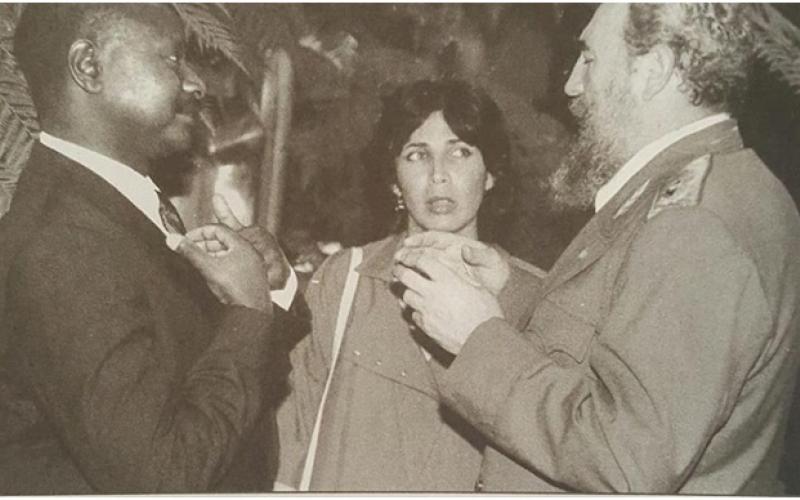
Museveni And Fidel Castro
Almost immediately after capturing the instruments of power, Castro made Africa the place to depict his military internationalism, humanitarian internationalism, and altruism in the face of adversity occasioned by crude colonialism. His was the Principle of International Solidarity, Socialism and the emancipation of Africa.
In a way he held the view that Cuba was not freed if humanity in other parts of the world, especially Africa, was under the yoke of colonialism. This explains why he was at the forefront of supporting liberation movements in and the decolonisation of Africa.
Very early he involved his revolutionary army just emerged from the bushes of Cuba in covert operations in Algeria (1961), Congo and Guinea Bissau (1964) and Angola (1975), with his greatest legacy in Africa being in Angola.
There is no doubt that Castro was a close ally of the African National Congress (ANC) and Mandela in the pushback of Apartheid South Africa. Indeed he gave a long and moving eulogy at the burial of Nelson Mandela when he died.
I don’t know to what extent the old man in absolute power was involved in President Tibuhaburwa Museveni’s guerilla war against Obote’s regime, but if we are to go by President Tibuhaburwa Museveni’s condolence message following the old man’s death, Castro was a friend, brother and leader who redefined Africa’s path to self-rule.
It is not clear what role he played in the insurgency of NRM/NRA in the bushes of Luwero in Buganda. However, when the new leader of Uganda in 1986, declared that he was going to integrate Uganda in global trade and business through Barter Trade, Cuba was one of the country the Uganda leader identified as one of the country he would engage barter trade with.
I don’t know also to what extent Fidel Castro influenced President Museveni by way of development philosophy and policies. But Cuba emphasizes science, especially health sciences and has done a lot to help African countries in the field of health. When President Museveni refused to respond to Doctors’ demand for justice in salaries and allowances he threatened to ferry in Cuban doctors.
Castro put a lot of emphasis on building the medical human resources capacity. But I don’t know what their hospitals are like. Cuba was one of the earliest countries to innovate a vaccine against Covid 19, which has ravaged the world for the last two years.
President Tibuhaburwa Museveni’s emphasis on natural sciences, at the expense of the humanities and social sciences, which he and his wife, erroneously refer to as, “those useless courses,” ignorant of the fact that social sciences are sciences and philosophy, is the highest form of science, because it is about one’s capability to reason, draw conclusions and make recommendations that contribute to improved knowledge by humankind for development, transformation and progress.
Kiira bus, Kiira car etc are supposed to be promoted in Uganda but the social sciences and the Arts, including the performing arts, are supposed to be suppressed in favor of the natural sciences. Don’t ask me what is happening to reason in Uganda. It is because the sciences are being disintegrated politically and n favour of laboratory based science.
If I is true what Dr Higenyi of Makerere University – that when he as Minister for barter trade and President Museveni visited Cuba in the early days of NRM/A rule – Castro remarked that it is easier to rule poor people than rich ones if you want to stay in power for a long time, then we should remember Castro for the miseries of the poor and needy. Most policies in Uganda promote poverty, not prosperity for the majority.
The Writer Is a Ugandan Scientist and Environmentalist.
DISCLAIMER: The views expressed in this article are solely and belong to the author or writer and don’t represent Verbatim Digital Media, it’s affiliates, owners or reporters. send your opinion or article to ultimatenews19@gmail.com or WhatsApp +254797048150 to have it published.
Refugees and Host Communities attend a Health talk by Reproductive Health Uganda at Pagirinya Health Centre III- Photo by Aldon Walukamba
By Lydia Nyaketcho
At least 300,000 women and girls get pregnant in Uganda’s refugee camps annually, but reproductive health services remain sparse.
Imagine yourself as a refugee from South Sudan, Burundi, Congo, Eritrea, Somalia, or any other country like Ethiopia has crossed into Uganda. It could be a long journey that includes travel through conflict zones. When you first arrive, your top considerations are likely to be food and shelter, as well as protecting your loved ones; family planning is likely to be the last thing on your mind.
Pregnancy does, however, occur in refugee camps, and conflict zones are no exception. Unfortunately, access to family planning may be limited in Uganda’s most vulnerable areas.
Although Ugandan refugees do not encounter the same difficulties, Scovia Tabaria, a 30-year-old refugee in Pagirinya camp with three children, claims that challenging pregnancies occur frequently when refugees are forced to escape their homes.
Scovia Tabaria and one of her children at her home in Pagirinya Refugee camp Adjumani district- Photo by Aldon Walukamba
Some women are forced to give birth alone; others make it to clinics but are in desperate need of blood transfusions and are kilometers away from the nearest blood bank. In Uganda, pregnant women and newborns are at danger of contracting sexually transmitted infections, mortality, and impairment.
According to Robert Andeoye, Settlement Commandant at Pagirinya refugee camp in Uganda, which houses 240,161 refugees, this is especially true for vulnerable people like refugees. Nearly one-third of deliveries in refugee camps are likely to result in life-threatening complications, necessitating immediate medical assistance that can only be provided by an expert.
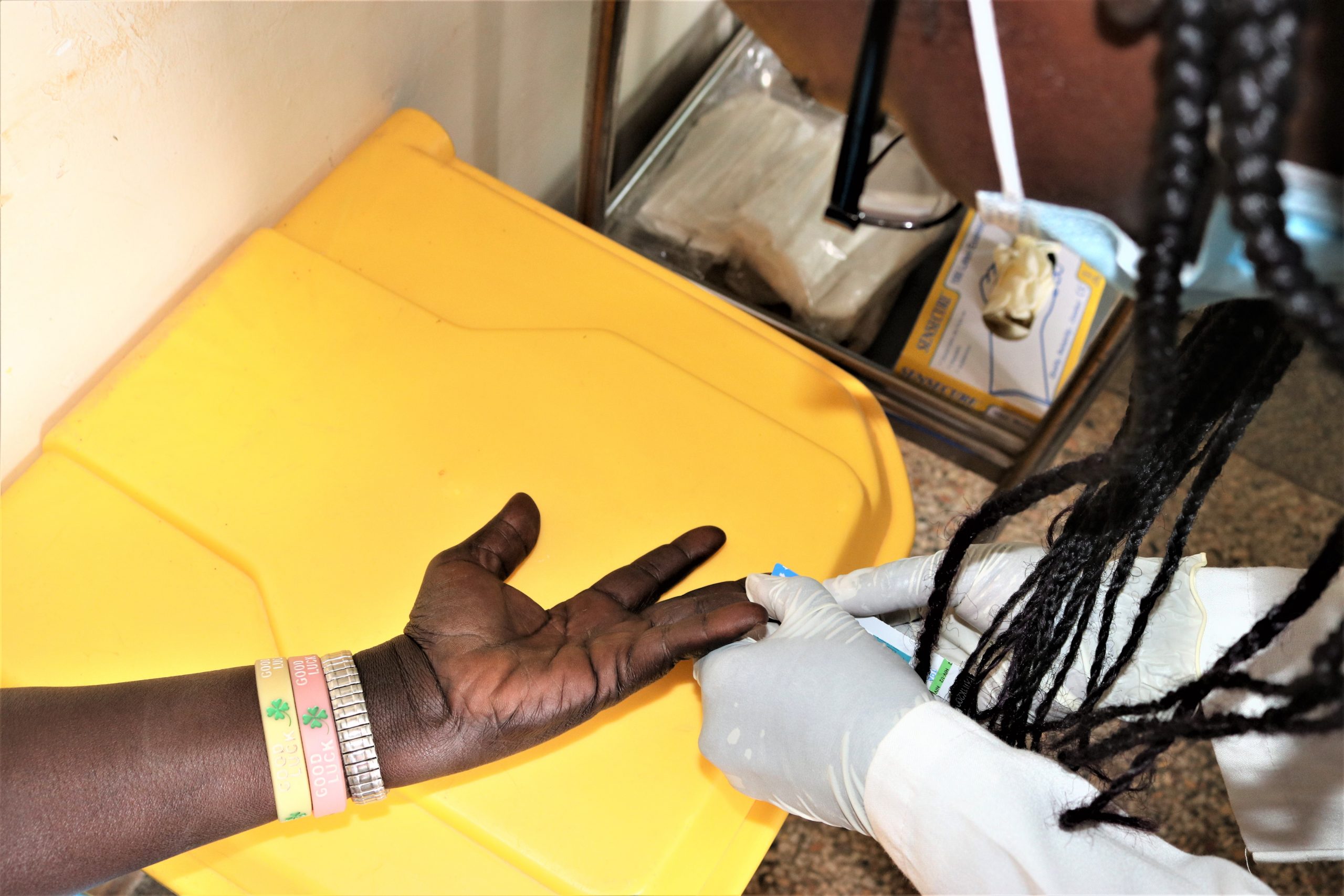
A woman refugee receiving an HIV test at Pagirinya Health Centre III in Adjumani district- Photo by Aldon Walukamba
When a woman has experienced the stress of escaping a crisis, delivery is more likely to be complicated, and medical help, such as antenatal care, is less likely to be accessible. Yes, the risks of pregnancy are increased, but in an emergency, reproductive health and rights are frequently overlooked.
Uganda had a poor functioning health system before the country’s home countries for refugees collapsed into civil conflict and natural disaster. Family planning was not free, and only around ten percent of women utilized it on a regular basis.
Despite this, only 7% of non-pregnant married women in Uganda used contraception the last time a major survey was conducted among refugees. According to the United Nations Population Fund (UNFPA), 300,000 Ugandan women and refugees will become pregnant in the next year. Refugees in Uganda frequently confide in charity workers that they are afraid of becoming pregnant, so why is family planning so uncommon?
Part of the explanation, according to Pauline Idia, Adjumani district Assistant Health Officer for Maternal and Child Health, is rooted in the same reasons that women lack information and healthcare in general. Uganda is failing to meet the need for basic healthcare among refugees, which has increased to 1.4 million.
Most refugees reside in makeshift camps outside of cities and have no idea where they may access healthcare, including family planning. Cost, knowledge, and transportation are all important considerations. The majority of clinics are privately owned and unreasonably expensive: a medicine prescription and a consultation fee may be only a few shillings, but most Ugandan refugees are completely dependent on their funds, which are rapidly depleting.
People will, understandably, be concerned about medical care for those who are already unwell, as well as obtaining food and housing for refugee populations. Colleagues from other NGO’s have told stories about putting up focus groups to evaluate family planning requirements, only to be interrupted by migrants who demanded to talk about food and jobs instead.
The solution, according to Annet Kyarimpa, Safe Motherhood Manager at Reproductive Health Uganda (RHU), rests in adjusting to the individual needs of refugees, whether they live in camps, host communities, or informal settlements. RHU, for example, uses outreaches and fixed clinics to bring healthcare to remote Ugandan villages.
With support from the Danish International Development Agency (DANIDA), we are prioritizing such clinics in Uganda to provide sexual reproductive healthcare and rights by choice, including integrated family planning services, to unregistered refugees in 19 settlements of Adjumani district, as well as Kampala urban refugees.
Integrated Family Planning (IFP) remains a less expensive approach of lowering pregnancy-related fatalities, and it is something that refugee women and those from host communities have frequently informed us they require. However, in comparison to Ugandan residents, vulnerable communities receive 50% less planning, financing, and attention for reproductive health.
However, Norbert Anyase, acting In-Charge of Pagirinya Health Centre III, which is run by RHU partner Medical Teams International (MTI), says that by addressing this diverse and often complex set of challenges, pregnancy can be the natural and life-affirming process it should be for refugee women who have already endured conflict and disaster.
By Charles Oweyegha Afunaduula
During the promulgation of the Uganda Constitution 1995 in 1997, the President of Uganda, who was promulgating it at Serena Conference Centre, then called International Conference Centre, if I remember well, declared that it was the best Constitution Uganda had got since independence in 1962. He even told his listeners countrywide that it would stand the test of time.
The question is: has the constitution stood the test of time as the Supreme Law of the Land? How, when State Capture and Presidentialism are growing at the expense of the Constitution sub served by militarism?
Wikipedia has defined State Capture as “a type of systematic political corruption in which private interests significantly influence a State’s decision-making processes to their own advantage. On the other hand Freedom From Fear Magazine sees State Capture as occurring when the ruling elite and /or powerful business manipulate policy formulation (and implementation), thereby influencing the emerging rules of the game (including the law).
Presidentialism arises when the President, the head of the Executive arm of Government, consumates the entire Executive and the other arms of Government – the Legislature and Judiciary -so that everything begins and ends with him and all elites -political, economic, technical, bureaucratic, etc – dance to his tune (my own definition). What then matters is the sovereignty of the President; not that of country. All institutions begin to function in relation to the President; not the Constitution. So the Constitution becomes peripheral to the governance of the country as the President becomes the central factor to everything -small and big – in the country. Even problems start with him (his choices) and end with him.
It is sad our constitutional lawyers, such as Prof. Oloka Onyango at Makerere University, have recently chosen conspiracy of silence.
The last time I heard Professor Oloka Onyango publicly giving a strong critique on the status of Constitutionalism in Uganda was in 2017 when he deplored Presidentialism in the governance of the country. He was disturbed by the fact that the Institution of President was penetrating every institutional space in the country and making itself over and above other arms of government, thereby confusing the functionality of constutionalism in the governance of the country. He could have pursued the matter in other media that I am not aware of. He is a prolific writer.
Presidentialism has meant that the Presidency (not so much the Executive arm of Government ) penetrates and weakens the other arms of Government – Parliament and the Judiciary – which now manifest as if they are extensions or dimensions of the Presidency.
In his article in the New Vision of 2nd June 2017 “The Phenomenon of Presidentialism Must Be Dealt With And Examined”,
David Lumu quotes Prof Oloka Onyango saying:
“For Uganda to sort out internal contradictions and set a firm foundation for institutional building, the idea that everything begins and ends with the President must be tamed”.
Lumu records Prof Oloka Oyango describing the over centralization of power into the hands of President Yoweri Museveni as the “phenomenon of presidentialism”, and rooting the phenomenon partly in the colonial history of the country.
Prof. Oloka Oloka Onyango, who was speaking at the launch of a book titled: “Militarism and the Dilemma of Post-Colonial Statehood: The Case of Museveni’s Uganda,” at Makerere University School of Law, then hit the hammer on the head of the nail when he said , “The idea that everything begins and ends in the Governor’s chambers is leading to internal colonialism. The phenomenon of Presidentialism must be dealt with and examined”.
It is clear that a combination of State Capture and Presidentialism , all mediated by the President of Uganda, is making it difficult and almost impossible for democracy, constitutionalism and institutionalism to work in Uganda. Uganda is now governed according to the choices of the President. “Unfortunately, the legislature and Judiciary find themselves in the unenviable position of being subordinate to the Executive and dancing to the tuñe of the President”, decries a political critic.
In an upcoming book “Uganda Essential Knowledge”, by a veteran journalist, in the last chapter, the author talks about the centrality of the Constitution in our governance, and quotes several sections on the duties responsibilities and obligations of the three arms of government, the media and the citizenry. He may have to rethink the Chapter after reading this article. The Constitution is under siege. It is being rendered peripheral to governance.
The Writer is a Ugandan Scientist and Environmentalist.
DISCLAIMER: The views expressed in this article are solely and belong to the author or writer and don’t represent the views of Verbatim Digital Media, It’s affiliates, owners or reporters. Send your article at ultimatenews19@gmail.com or WhatsApp +254797048150 to have it published
In his end of year message to Ugandans on 31st December 2021, president Museveni re-affirmed that indeed schools will re-open to learners on 10th January 2021 after being closed for two years.
The president in his address also committed to full reopening of the economy where public transport was opened to full capacity, bars, concerts and all other businesses that had been locked will now resume operating normally under strict Standard Operating Procedures including removal of the dawn to dusk curfew.
However, while announcing the re-openning of schools, President Museveni directed the ministry of works, Health and education to work on a plan that will see all children back to school without chaos and overcrowding.
To this effect, the Ministry of Health has issued a reporting plan for all boarding students in schools around Kampala, Mukono, Wakiso and Mpigi as seen in the plan below.
Towards the end of 2021, House of prayer lead pastor was at the receiving end for marrying a second wife while still legally married to his first wife Teddy Naluswa Bugingo. The Canan land boss reached to an extend of denying that he was introduced by the love of his life Suzan Makula.
Word was on street that while responding to police summons on 22nd December 2021, Pastor Bugingo denied that he was never introduced by Suzan Makula as alleged, what happened was that he just accepted an invitation to Makula’s home but not to attend an introduction ceremony.
suzan makula introduces pastor bujingo
His unsettledness comes at the height of criminal summons issued against him and risks 5 years in jail according to city lawyer Male Mabirizi who dragged him to court immediately after the flashy introduction ceremony that attracted big names on 17th November 2021.
Bugingo and Makula are set to appear in court on 21st January 2022 for mention of their case, Bugingo’s allies like Ex- Lubaga South legislator Kato Lubwama who attended the function have since changed tone claiming what they attended was not an introduction ceremony in defense of their colleague who seem to be having troubles.
Bugingo is also battling to divorce his old wife Teddy Naluswa so that he legally settles in with his Salt TV employee Suzan Makula but it seems to be also another hustle since the first wife has vowed never to sign the divorce papers claiming she’s still Bugingo’s official wife even in front of God.
Watch the space and we shall update you on how events unfold at Canan land.