Thursday, April 23, 2026
Home Blog Page 10

Farmers Face Severe Losses as Catastrophic Hailstorm Strike Zombo District

0

By Mike Rwothomio

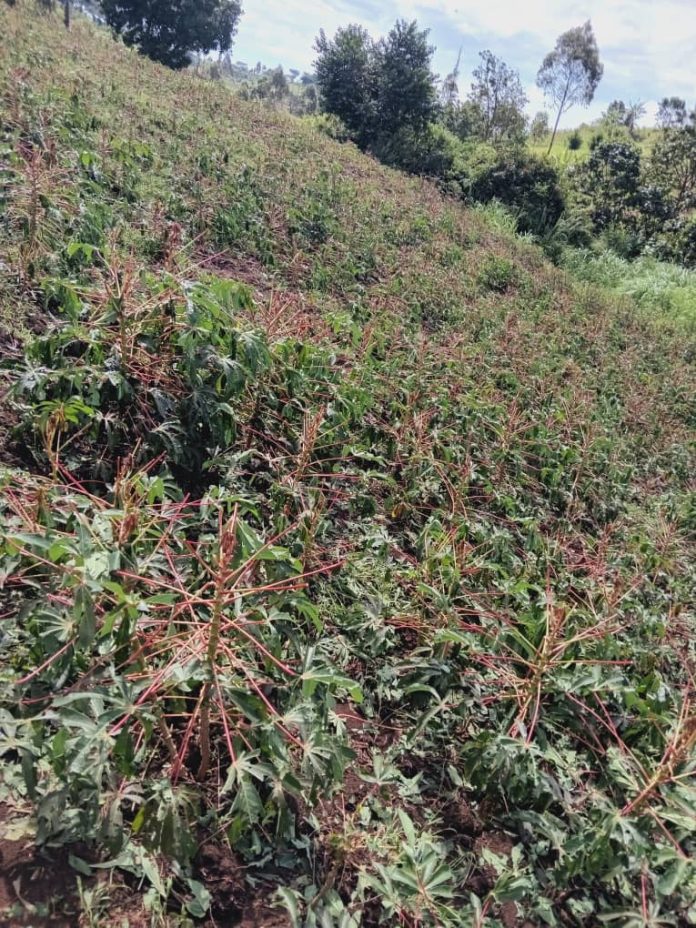
A severe hydro meteorological disaster, characterized by torrential rainfall and a destructive hailstorm, struck Jupandindu ward in Padea town council, Zombo District, exacerbating the area’s vulnerability to food insecurity and potential famine on the evening of May 22, 2025.

This disaster caused widespread devastation to agricultural livelihoods, obliterating critical staple crops such as maize, beans, cassava, and avocado plantations.

The affected areas, particularly the cells of Limu, Omva, and Awilli, experienced near-total crop failure, compounding the socio-economic and psychological impacts on local farmers.

The destruction of these vital food sources has heightened the risk of famine, with hundreds of farmers facing acute food insecurity.

Melki Onyutha Orwothuwun, the LCIII Chairperson of Padea town council, described the crop damage as “immense” and issued an urgent appeal for intervention from the district disaster management committee and humanitarian organizations to mitigate the crisis.

Local farmers, through their leaders, have reported significant losses, leaving communities in a state of economic and psychological distress.

Historically, Zombo District benefited from dense vegetation cover, which provided a natural buffer against extreme weather events. However, since the early 2000s, rampant deforestation and depletion of forest reserves have increased the area’s exposure to disasters such as hailstorms, floods, and strong winds. This environmental degradation has amplified the impacts of climate-induced hazards, as noted by local environmentalists.

Denis Dongwa, Zombo’s Secretary for Production, and councilor Francis Bolingo, members of the production committee, instructed Padea leadership to compile a comprehensive disaster impact assessment report for submission to the committee for further action.

Festus Ayikobua, the Resident District Commissioner of Zombo, committed to escalating the report to the Chief Administrative Officer (CAO) to secure support for the affected communities.

The disaster follows a similar event in 2024, when torrential rains and hailstorms devastated Abanga sub-county, affecting the parishes of Serr and Pakadha, and destroying crops critical to local food security.

The district disaster management committee has repeatedly raised concerns about inadequate funding, which hampers effective disaster preparedness and response, leaving communities increasingly vulnerable to recurring climate-related hazards.

In 2021, floods, landslides, and hailstorms affected multiple Ugandan districts, including , Kapchorwa, Sironko, Mbale, Bukedea, Kapelebyong, and Katakwi, with 17 districts reporting significant damage due to prolonged heavy rainfall. These events destroyed water facilities, increasing the risk of waterborne diseases like cholera and typhoid.

Hailstorms, characterized by solid precipitation in the form of ice balls, typically last less than 15 minutes but can cause severe damage to crops, buildings, and infrastructure, according to environmentalists.

In Uganda, hailstorms have been identified as one of the seven priority hazards, alongside floods, droughts, landslides, lightning, windstorms, and earthquakes, according to the National Risk Atlas (2019).

The destruction of crops in Zombo in 2025 further elevates the risk of famine, particularly in rural areas reliant on subsistence agriculture.

According to the Uganda National Meteorological Authority (UNMA), Uganda experiences two primary rainfall seasons: March-April-May (MAM) and September-October-November-December (SOND), with northern regions, including Zombo, often receiving substantial rainfall during June-July-August (JJA). In February 2025, UNMA reported dry conditions with high temperatures across most of Uganda, making the sudden onset of heavy rainfall and hailstorms in May particularly disruptive.

OPINION: Towards Hereditary Militarism In Uganda

0

By Oweyegha-Afunaduula

Centre for Critical Thinking and Alternative Analysis

The rise of violence and the gun culture in Uganda, like in the United States, Canada and other countries cannot be separated from the rise in militarism.  Militarism is the belief that a country must maintain a strong military capability and must use, or threaten to use, force to protect and advance “national interest” (e.g., Steuter and Martin, 2019).

During President Tibuhaburwa Museveni’s bush war in the Luwero Triangle of Buganda many children, called kadogos, were socialized into violence.  Beyond the bush war, many school going children were socialized into violence via Mchaka Mchaka, paramilitary groups and exposure to violence.

Besides, militarization of everything possible, including legislation, justice fisheries and development, frequently involving violence, is teaching the present generation of Ugandans that violence should be at the centre of leadership and governance.

Adelman (2003) linked, military, militarization and the militarization of domestic violence. There is no doubt that over the last 40 years, one of the most thriving industries in Uganda is the militarization of domestic violence. Everywhere young people have adopted violence to survive. Unlike before, violence in homes regarding inheritance, property and marriage, increasingly resulting in killings and suicides, is now widespread throughout the country.

A rising or potential source of violence in Uganda today is land grabbing, either by government on behalf of investors, government officials, military officers, police officers or nomadic pastoralists with exogenous origins. This is pushing the settled indigenes of the country to the margins of survival where they are just etching a living.

An increasing number of them is exposed to hunger because farmers have been dispossessed of their land, displaced and forced to migrate to areas where they are not biologically, historically, ecologically, culturally and psychologically connected and their belonging and identities are not shaped.

They are angry people. Because they are now internal refugees seeking livelihood in areas where they have no belonging, they are meeting resistance in some areas, often violently. In some cases, violence has been used to settle differences in culture, belonging and identity, often unsuccessfully, promising more violence in future.

Steuter and Martin (2019) suggested that family professionals can help parents become aware of the militarization process and then give them strategies for reducing its effects. Thankfully, professionals, parents, and families can create change by focusing on the ways in which peace in the home extends to peace in the world. Parents can practice peaceful options in their own lives and encourage them in their family.

They can take care not to raise children as future soldiers by default, but to choose toys, video games, clothing, television shows, and movies that serve the values of peace. From a position of strength, parents, families, and communities can work together and advocate for policy changes at all levels that cultivate a peaceful culture (Steuter and Martin 2019). However, peace should not be primarily seen physical terms, because that will only lead to further militarisation of society and cultivate a culture of violence in a century of internet, new and different knowledge and artificial knowledge.

Access to resources, such as water and underground wealth, will be the main cause of clashes. Currently, underground resources, such as gold and rare earth minerals in Busoga, are being clandestinely exploited by people of Rwandese, Chinese and Indian extraction secured militarily by members of the security organs of the country at no benefit to the Basoga. Fortunately, the Basoga are naturally peace-loving.

They have not shown that they will resort to violence to secure access to their resources. However, like is the case in oil-rich Nigeria, where the oil firms have impoverished the people and the people have resorted to violence in pursuit of resource use justice, the increasingly young population of Busoga, with diminishing opportunities, could one day be compelled to resort to violence because there is no evidence that justice in resource use justice is a critical issue central to development in Uganda today.

The ten billion question is: Has Uganda been led and governed for peace and security well in future or for momentary peace and security for the benefit of leaders and governors?

There is evidence to suggest that peace and security building today is more to secure the leaders and governor of the country than for the current and future generations of Ugandans. This could explain the supersonically rising security budget and militarization of the country and everything -in all dimensions of our environment (ecological-biological, socioeconomic, sociocultural and temporal).

The greatest threat facing Uganda today is the duality of hereditary politics and hereditary militarism. If the duality is allowed to entrench itself, it will be extremely difficult for Ugandans to erase dynastic rule, political cultism, and family rule well in the future.

In this article, I want to write about hereditary militarism. I have before written about hereditary political leadership in Uganda (Oweyegha-Afunaduula, 2022), which has imposed a few, mainly closely ethnically-related families, as the source of leaders and governors at the national, district and local levels. This is internally potentially violence-packed in the medium and long-term.

It partly explains the rising state violence in the country, siphoning off a lot of public money to sustain and support the ruling, increasingly politically hereditary-like ruling families that do not want to lose their privileged political status, which affords them economic, financial and social domination of Ugandans..

Hereditary militarism, while not a widely used term, suggests a system where military values, traditions, and practices are passed down through generations, often within a specific family or lineage. This could involve a focus on military service as a valued profession, a reverence for the military, or a belief in the superiority of military strength.

Leaders and governors who value hereditary militarism tend to stay in power for a long time and manifest as if they are indispensable. Frequently they are called dictators or tyrants. They use their influence to create heredity by constitutional prescription.

Theirs is succession by force. However, constitutionally prescribed arrangements for ensuring the succession are not always so successful, and many countries whose constitutions contain very similar provisions have experienced succession crises that were resolved only by violence.

Frequently, the man of power chooses one of his offsprings to succeed him rather than pass the instruments of power to a member of his party or to another in another party. In another article “How Dictators Legitimise themselves and Consolidate their Power” (Oweyegha-Afunaduula, 2025) I showed that some leaders prefer to rule unchallenged and prepare their sons offspring to take over from them. However, many times members of the ruling family are compelled to use violence to liquidate each other. The survivor takes the reigns of power without any recourse to the people he is going to rule.

Although dictators still occasionally seek to establish their sons as their heirs, they usually rely on force rather than the claims of heredity to achieve their object. Apart from a few states where the dynastic ruler is the effective head of the government, the hereditary principle of succession is now almost exclusively confined to the constitutional monarchies (Heslop, 2025).

There is widespread belief that the President of Uganda, Tibuhaburwa Museveni, has for long been in for dynastic rule not only in Uganda but in the Great Lakes region, and his commitment to East African Community and its expansion towards including the whole of the Great Lakes region, is geared towards this goal.

People cite his almost cult-like personality, suppression of democratic norms, and his belief that he is the true representative of Uganda and democracy in the country as well as regional unity and cooperation in East Africa and the Great lakes region, as the resources he has built to project himself as most suitable candidate for a regional leader. However, they note that he is in his twilight of life and that all his recent decisions and actions indicate that he is aware that he cannot hold on to the reigns of power for ever.

President Tibuhaburwa Museveni has severally pronounced that he cannot hand over the instruments of power to people he calls criminals (read leaders of political parties). To this end, he has kept his criminals in political and military chains, ensuring that they are restricted to the headquarters of their parties so that they do not meaningfully interact with the populace the way he does.

Some of the political leaders are not known widely within the country, and are only heard of via television, radio, newspapers and social media. Meanwhile he has been fast-tracking his son, Muhoozi Kainerugaba, through the ranks and posts of his army, Uganda Peoples Defense Forces (UPDF), which is actually constitutionalized National Resistance Army (NRA), which he used to wage a five-year bush war in the Luwero Triangle.

Indeed, during the promulgation of the Uganda Constitution 1995, he preferred NRA to UPDF. Today, Muhoozi Kainerugaba is not only a General of the army but also the Chief of Defense Forces (CDF) with far more powers than all other people who held that post before in the Army.

From that post he has also declared they (meaning President Tibuhaburwa Museveni and himself and perhaps his uncle, General Salim Saleh Akandwanaho Caleb) can never hand over power to the Criminals (read alternative political leaders). He also stated that civilians will never rule Uganda again. In both cases his statements were received with silence of approval from his father.

Therefore, already, General Muhoozi-Kainerugaba thinks, believes and is convinced that the next ruler after his father is himself. Most of his supporters also think, believe and are convinced that he will succeed his father as the ruler of Uganda.

He already has his political group called Patriotic League of Uganda, which is within the NRM but could be easily weaned off as his political foundation, so that he manifests as the political military ruler the same way his father has done for 40 years.

Recently, President Tibuhaburwa Museveni erroneously but legislatively engineered and fast- tracked the enaction of the UPDF Act 2025 to commit Ugandans to the military court. He used his executive, powers, his influence on the NRM caucus in parliament and money, to get the UPDF Act 2025 enacted.

His thinking, belief and conviction was that the Act could be used deter the militant young people from violence. It is also thought that he wants to use it against his political opponents. However, the one who will use it most after him will be the CDF. He already wields a lot of power under the reign of President Tibuhaburwa Museveni.

Already the military and military culture has surely invaded our everyday life and are set to do so even more when the UPDF Act 2025 is signed into law by the President. Totalitarian or autocratic rule is now legislatively served by law. The UPDF Act 2025 is also the blueprint for military justice over civilians.

This explains why President Tibuhaburwa Museveni and General Muhoozi Kainerugaba immediately thanked Members of Parliament for passing the UPDF Act into law.  Totalitarianism is now legally legitimised in Uganda

Totalitarianism has been a chief form of autocratic rule in many countries.  It is distinguished in its use of state power to impose an official ideology on its citizens. Nonconformity of opinion is treated as the equivalent of resistance or opposition to the government, and a formidable apparatus of compulsion, including various kinds of state police or secret police, is kept in being to enforce the orthodoxy of the proclaimed doctrines of the state (Heslop, 2025).

A single party, centrally directed and composed exclusively of loyal supporters of the regime, is the other typical feature of totalitarianism. The party is at once an instrument of social control, a vehicle for ideological indoctrination, and the body from which the ruling group recruits its members (Heslop, 2025).

Accordingly, with totalitarianism legitimized legislatively in Uganda, the NRM is destined to become and manifest as an instrument of social and political control, a vehicle of ideological control and the body from which the ruling family group will recruit its members.

I have already written an article casting NRM as a personalist political organization with a personalist ruler of Uganda, President Tibuhaburwa Museveni, as its chairman, enroute being succeeded by his son, General Muhoozi Kainerugaba in the spirit of hereditary militarism (Oweyegha-Afunaduula, 2025) .

Uganda of the 21st Century is squarely under hereditary militarism. The Parliament of Uganda has participated in building hereditary militarism in Uganda and is now integral to it.

Accordingly, the Parliament of Uganda is at the centre of building military justice and eroding civilian justice in the country and, therefore, also eroding the integrity of the Judiciary of Uganda by the Executive. In essence, the Parliament of Uganda has helped the Executive to erode constitutionalism in favour of disguised hereditary military in Uganda.

For God and My Country

DISCLAIMER: The views expressed in this article are for the author. They don’t represent those of Ultimate News, it’s affiliates, owners or employees. If you have a story in your community or an opinion article, let’s publish it. Send us an email via ultimatenews19@gmailcom

OWEYEGHA-AFUNADUULA: How Dictators Legitimise Themselves And Consolidate Their Power

0

By Oweyegha-Afunaduula

Center for Critical Thinking and Alternative Analysis

A dictator dictates. He or she may seek to know your thinking or your idea about something or even follow your reasoning with interest but ultimately, he or she will follow what his or her mind tells him or her and enforce it with all the power in his or her hands. He or she will then proceed to build his or her legitimacy, the legitimacy of his or her regime or the legitimacy of his or her government.

Many claim themselves kings or queens, and many work hard and prefer to pass the reigns of power to one of their offspring. One-time former Libyan strongman, Mammuar Gaddafi called himself King of kings. After 42 years in power, many Libyans believed Gaddafi was a dictator, although he delivered goods and services, such as building houses for them, giving them free electricity and free water, after building a river in reverse direction.

People wanted democracy, freedom and democracy, besides the social goods and services, but he died these three from them. Connolly (2011) saw Col Muammar Gaddafi as renowned not just for his cruelty, but also his theatricality and a tyrant in the mould of Mussolini, Idi Amin and Omar Bongo. He asked if Gaddafi could be the last of the line. Of course not. There were dictators before him and there will be dictators in Africa long after him.

President Tibuhaburwa Museveni is considered by many in Africa and outside Africa as a dictator. He is one of Africa’s longest serving leaders. His rule brought many changes in Uganda. He is a very strong believer of dictatorship and absolutism, In 2005, he scrapped presidential term limits and the presidential age limit in 2017, which two actions, using Parliament, opened the way for him to manifest as an absolute ruler.

President Tibuhaburwa Museveni of Uganda waged a five- year bush war in the Luwero Triangle of Buganda, leading to hundreds of thousands losing their lives. He promised freedom, justice and democracy. The title of his once popular book is “Sowing the Mustard Seed: The Struggle for Freedom, Justice and Democracy.

However, after capturing the instruments of power in 1986 and promising “a fundamental change, not a mere change of guards”, time, which is the best judge, has revealed that freedom, justice and democracy were not the goal of President Tibuhaburwa Museveni’s Bush War but power to achieve his goals of liberation of a small exogenous ethnic group, wealth, glory and domination of the naturally indigenous groups of Uganda.

40 years later, President Tibuhaburwa Museveni is still in power and building hereditary politics and hereditary militarism. All indications are that he wants power to remain in his hands and his family well beyond his personal reign.

Many Ugandans and foreigners in and outside Uganda now think, believe and are convinced that President Tibuhaburwa Museveni has mutated from a liberator he sold himself to be a formidable dictator (e.g., Mugabi, 2028). The seeds of absolute power were always there.

At one time, President Tibuhaburwa Museveni, very early in his rule, called himself Ssabagabe, which is the same as saying “King of kings”. In 1962 when Uganda got political independence from the British colonialists, there were four hereditary Kings: the Kabaka of Buganda, the Omukama of Bunyoro, the Omukama of Toro, and the Omugabe of Ankole.

There was also the Kyabazinga of the Territory of Busoga, with King-like Status. In 1966, Apollo Milton Obote abolished all of them. However, when Tibuhaburwa Museveni, after capturing the instruments of power in 1986, was greeted with calls to restore the Kingdoms and semi-kingdom of Busoga.

Even if he persisted in saying that he did not go to the bush to restore kingdom, when he presided over the making of the Uganda Constitution 1995, he showed that he meant business when he said he did not go to the bush to restore kingdoms.

The constitution does not contain the words Kingdoms and Kings. Instead, it contains the phrases “cultural institutions” and “Cultural Heads”. However, while all the former Kingdoms and Kings see themselves in those phrases, the Ankole Kingdom (Obugabe) is completely abolished.

Since the promulgation of the Uganda Constitution 1995, President Tibuhaburwa Museveni has ruled like a Life President. Although, since he subjected himself to electoral politics in 1996, he has effectively excluded alternative leaders in his politico-military organization – National Resistance Movement (NRM) and others in alternative political parties from meaningfully and effectively competing for political power. He has ruled like a mega-King (a Ssabagabe) with a personalist politico-military organization.

Until today, there have been persistent calls by members of NRM to President Tibuhaburwa Museveni to show them a successor. However, he has preferred silence on the matter, interspersed with growing influence on the Executive, Legislature, Judiciary and all the institutions of State. IN terms of action, he fast-tracked promotions his only son – Muhoozi Kainerugaba – through the military ranks and major posts in the National Resistance Army (constitutionalized in the Uganda Constitution 1995 as Uganda Peoples Defense Forces, UPDF).

Today, Muhoozi-Kainerugaba is a General and Chief of Defense Forces (CDF) in which capacity he has a lot of powers, previously exercised by President Tibuhaburwa Museveni, such as promoting military leaders, and can do anything under the Sun. For example, during the by-election in Kawempe North, he admitted that he was the one who despatched the paramilitary group called JATT, which reined a lot of havoc.

President Tibuhaburwa Museveni used a lot of influence and money to ensure that the Parliament of Uganda enacted a new UPDF Act 2025, which allows for military justice over certain categories of civilians. In essence, the UPDF Act 2025 is the tool that President Tibuhaburwa Museveni and the CDF will use to govern Uganda together militarily and administer military justice as and when the two with.

Even if President Tibuhaburwa Museveni has not pronounced that General Muhoozi Kainerugaba is his successor, the thoughts and actions of the President and his son depict that the President has a heir: a politico-military heir in the person of Muhoozi Kainerugaba.

It is hereditary Militarism in action. If this is the case, then President Tibuhaburwa Museveni is a military dictator clothed in democratic attire. He has shown love for all practices that depict him as such, and which show that Uganda has all the time been governed towards hereditary militarism.

One writer, cited by QUORA, said that dictators may claim the title of “king” or adopt king-like behaviors for several reasons, including:

  1. Consolidation of Power: By positioning themselves as a monarch, dictators can legitimize their authority and create a sense of permanence. This can help suppress opposition and dissent, as they frame their rule as a natural extension of a historical or cultural legacy.
  2. Dynastic Rule: Dictators often wish to establish a dynasty, where power is passed down to their heirs. This can create a sense of stability and continuity for their regime, as well as ensure that their personal interests and policies are maintained beyond their own tenure.
  3. Cult of Personality: Many dictators cultivate a cult of personality, portraying themselves as larger-than-life figures. By adopting royal titles or behaviors, they enhance their image and promote loyalty among their supporters, who may see them as a father figure or protector of the nation.
  4. Cultural and Historical Context: In some regions, historical precedents of monarchy influence modern governance. Dictators may invoke royal imagery to tap into national pride or historical narratives, aligning their rule with traditional authority.
  5. Suppression of Democratic Norms: By claiming royal-like status, dictators can undermine the principles of democracy and governance. This often involves eliminating political opposition, controlling the media, and manipulating public perception to maintain their grip on power.
  6. Symbol of National Unity: Dictators may present themselves as the embodiment of the nation, similar to how monarchs have historically been viewed. This can foster a sense of national identity and unity, even if it is based on coercion and fear.

The adoption of king-like titles and behaviors by dictators or dictator-like rulers, serves to reinforce their power, legitimize their rule, and establish a legacy that they hope will endure beyond their lifetime. In fact, their hope is that by the time they leave physical life, they will have established family rule based on hereditary politics and hereditary militarism.

I have written about hereditary political leadership in Uganda before, wherein former kings in the country were erroneously, but constitutionally, reduced to cultural institutions without political power soon after President Tibuhaburwa Museveni called himself Ssabagabe and resisted raising the former Kingdom of Ankole (Obugabe) among his new cultural institutions.

I have yet to write about hereditary militarism, but in Uganda the boundary between hereditary militarism and hereditary politics is absent because we have political military leadership with all power in the hands of the military, with military officers at the centre of governance in every sphere of human endeavour.

This particular article is about how exactly dictators build and maintain their legitimacy, consolidate their power and go on to establish out-blown or concealed military rule with sovereignty over the Executive, Legislature, Judiciary and all institutions of the State. Weakening of constitutionalism and the institutions of state is the ultimate phenomenon accompanied by rising presidentialism and personalist power.

Dictators are frequently also called tyrants and tend to use a variety of methods to establish and maintain legitimacy. They often employing propaganda, controlling information, and using force to suppress dissent. They may also hold rigged elections, claim to represent the will of the people, or manipulate cultural narratives to appear legitimate.

Muradiaga (2024) has written that for tyrants, private property is one of the first barriers to be levelled in pursuit of despotic power. Worse still, assets that tyrants steal can then be used to prop up their unfree regimes, extending their iron-fisted sway by spending wealth that the regimes’ cadres never earned or worked for.

Muradiaga (2024) adds that economic, financial, and asset-based repression represents a systematic strategy employed by authoritarian regimes to consolidate and sustain political control through financial institutions and legal frameworks designed to restrict, monitor, and penalize dissidents, critics and [alternative political parties and leaders].

This form of repression entails the instrumentalization of all available financial tools, both national and international, to neutralise political, civic, or social opposition while undermining the economic autonomy of critical people and groups (Muradiaga 2024).

Recently, the Parliament of Uganda passed a law simultaneously with the UPDF Act 1995 to help President Tibuhaburwa Museveni deprive alternative political parties of financial power. Financially poor parties cannot meaningfully and effectively carry out their political work and stand up to the NRM, whose access to State resources make it financially strong. The financial resources it has ends up equipping itself with capacity to buy political opponents and finance agents that penetrate the alternative political parties.

The financial squeeze of Opposition in Uganda on account of not meeting with the President in meetings such as those of IPOD is seen in the latest law regarding government financing of political parties in the country passed by Parliament simultaneously with the UPDF Act 2025.

According to Muradiaga (2024), in its most basic form, economic and financial repression for political control can manifest as confiscation of physical assets, such as land, properties, and businesses, under legal pretexts justifying expropriation.

As financial technology has advanced and economies have become digital, however, authoritarian regimes have added newer methods that enable deeper, more precise control over the population. Muradiaga’s (2024) list of tactics that dictators use to squeeze alternative political leaders or bases includes:

1) Financial surveillance and violation of banking privacy. Authoritarian states will access (legally or not) the banking data of individuals and organizations, including their credit-card spending and any other financial flows that can be monitored. Through international-cooperation mechanisms meant to help in the fight against crime and terrorism, and through the use of Financial Intelligence Units (or FIUs — state agencies designed to keep tabs on suspicious financial dealings), regimes can track dissidents’ money in real time, both domestically and internationally.

2) Charges of money laundering and illicit financing. These are among the most effective tactics that authoritarian regimes can use in their efforts to delegitimize and criminalize opponents. Under the guise of fighting crime or terror, governments will freeze accounts, seize assets, and suspend the ability of individuals and organizations to operate. Groups that are deemed regime-unfriendly and that receive international donor funds are especially vulnerable.

3) Confiscation of physical and financial assets. In addition to surveillance and financial control, authoritarian regimes confiscate physical assets such as properties, homes, businesses, and other tangible resources. These expropriations are often justified by laws meant to stop money laundering or support national security, but which also allow the state to strip assets from regime opponents.

4) Manipulation of national and international financial institutions. Authoritarian regimes coopt both national financial institutions (banks, central banks, finance ministries) and international organizations through norms and regulations such as those of the Financial Action Task Force (FATF) to impose sanctions and financially isolate critics. This enables authoritarians to block access to global financial systems, cutting off critics from any possibility of receiving donations, conducting international transfers, or even conducting basic transactions.

Napoleon Bona Parte said he was the true representative of the people and the pillar of democracy in France even if he knew his was a military state. He was able to use the Parliament to convert himself from a military leader to an Emperor. He completely usurped the sovereign powers of the Parliament and made it dance to every tune he played in terms of administration, leadership, governance and war.

During his political ideology (Bonapartism) was supreme and unchallenged and all leadership and governance sprang from it. He was an absolute ruler. His Parliament gave a semblance of parliamentary system, it placed significant power in the hands of the First Consul, Napoleon, who appointed many officials and controlled the legislative process.

In the case of Uganda, the latest show of President Tibuhaburwa freeing himself from the people of Uganda and their representatives in Parliament is definitely the new Uganda People’s Defense Forces (UPDF) Act 2025, which gives a lot of power to the President’s son, Muhoozi Kainerugaba who for all, intent and purposes, is the chosen heir to the Presidential throne.

Both President Tibuhaburwa Museveni and General Muhoozi Kainerugaba have thanked the Members of Parliament whom, reportedly, the former referred to as children, for passing the UPDF Act 2025, which consolidates power in their hands. In the thinking of the President, those Members of Parliament who did not support the Act in its entirety were anti-Uganda and anti-people and should apologize.

It is becoming increasingly clear that President Tibuhaburwa Museveni can never be defeated through elections his government organises. He is seeking another term through an election in 2026. However, he is already militarily preparing to ensure that he emerges the winner. Even when he knows biometric voting can’t work effectively in Uganda, he has shown it is the one he prefers.

He first claimed Kyagulanyi Ssentamu stole his 1 million votes during the 2021 elections (Draku, 2025).  Just as I write, he has claimed Kyagulanyi Sssentamu stole 2.7 million votes in collusion with the Electoral Commission, which he singularly composes. Clearly, the results the next elections will not be decided by the voters but by rigging.

Already the President claims more than half the population of Uganda belong to his Party, which he and his supporters claim is a mass party, even if most of the population consists of young people born after he grabbed power. Because he has never believed in pluralism, he is using money to destroy the integrity of the political parties.

Meanwhile, political opines, whom he has repeatedly referred to criminals may either be treated like the power vandals of Luwero (URN, 2025) or subjected to military justice under the UPDF Act 2025. In both cases the person at the centre in the CDF, General Muhoozi Kainerugaba who will be hard put to carry out the orders of the Commander in Chief, who is is his father.

A future ruler of Uganda can use the UPDF Act 2025 to consolidate power and decide to do away with Parliament the way President Idi Amin did and was able to rule the country for 8 years. With military justice, even the Judiciary of Uganda is already weakened.

Time will tell whether the father and son will free themselves from Uganda and from the people and how.

For God and My Country

DISCLAIMER: The views expressed in this article are solely for and belong to the author/ writer. They don’t represent those of Ultimate News, it’s affiliates or owners. If you have a story in your community, let’s publish it. Send us an email via ultimatenews19@gmail.com


See What You Should Do If You Wish To Catch Your Partner Cheating

0

Suspecting a partner of cheating can be emotionally draining and mentally exhausting. The sleepless nights, the nagging doubts, and the subtle changes in their behavior can leave you feeling helpless.

However, if you want definitive proof of infidelity and peace of mind, there’s a powerful solution that many turn to—Shaba Mangube Doctors and their renowned spells.

For centuries, spiritual healers and spellcasters have played a role in unveiling secrets and hidden truths. Shaba Mangube Doctors specialize in revealing the unseen, using their expertise to expose cheating partners.

Their spellcasting services are designed to bring clarity and truth into your life, ensuring you no longer live in uncertainty.

One of the most effective methods they offer is the Truth Revelation Spell. This spell works by enhancing your intuition, making it easier for you to notice inconsistencies in your partner’s behavior.

It also influences their subconscious, making them more likely to slip up and reveal the truth. Whether through accidental confessions or caught-in-the-act moments, this spell increases the chances of uncovering infidelity.

Another powerful method is the Fidelity Attraction Spell, which not only helps expose cheating but also strengthens the bond in your relationship.

If your partner is straying, this spell works to redirect their energy back to you, reigniting lost passion and ensuring their focus remains on your relationship.

Many people who have sought help from Shaba Mangube Doctors report incredible results, with some saying that their unfaithful partners confessed without even being questioned.

Others claim that unexpected signs—such as misplaced texts, revealing conversations, or sudden behavioral changes—surfaced almost immediately after the spell was cast.

If you are ready to unveil the truth and stop living in suspicion, consulting Shaba Mangube Doctors might be your answer. Whether you wish to catch a cheating partner or restore trust in your relationship, their spells are designed to provide clarity, healing, and ultimate peace of mind. Don’t let doubt consume you—seek the answers you deserve today!

For Consultations Call,
Phone: +254720202299
Email: shabamangubedoctors@gmail.com

>>>>DISCLAIMER: This is a testimonial article<<<

“After I Struggled To Pay Her Tuition At The University, She Dumped Me On Her Graduation Day” Boda Boda Man Painfully Tells

0

When Jackson Omondi, a humble boda boda rider from Kisumu, met Rose Achieng during her first year at university, he was instantly drawn to her.

Despite his modest income, Jackson did everything he could to support her through her education.

He took extra shifts, sacrificed his own comfort, and at times went without meals—all to make sure Rose’s tuition was paid and she had everything she needed to succeed.

“I believed in her. I saw her as my future,” Jackson recalled with emotion in his voice. “I thought we were building something together.”

But what was supposed to be the happiest day of their lives turned into his worst nightmare. On Rose’s graduation day, instead of celebrating with Jackson, she coldly ended the relationship. She told him she wanted a different life—one he couldn’t provide. Jackson was left heartbroken and humiliated.

“I felt like my whole world collapsed. After everything I did for her, she just walked away without even looking back,” he said.

Months passed. Jackson tried to move on, but the pain lingered. Meanwhile, Rose’s life took a turn. Despite her degree, she struggled to find stability.

Relationships she entered didn’t last, and nothing seemed to bring her peace. That’s when she decided to seek help from the renowned Shaba Mangube Doctors, known for their powerful traditional remedies and love spells.

In a surprising twist, the spell seemed to work. Rose began having vivid dreams about Jackson and felt an overwhelming pull to return to him. Eventually, she swallowed her pride and reached out, asking for forgiveness and a second chance.

“At first, I didn’t know what to do,” Jackson admitted. “Part of me was still hurt. But I also saw the sincerity in her eyes.”

Today, the two are working on rebuilding what was once broken. While many question whether love rekindled by spells can truly last, Jackson believes in second chances—though with caution.

“Maybe it was destiny. Or maybe the doctors really have power. Either way, we’re trying again, and this time, with open hearts.”

For Consultations Call,
Phone: +254720202299
Email: shabamangubedoctors@gmail.com
Website: www.shabamangubedoctors.com

>>>>DISCLAIMER: This is a testimonial article<<<<

“How I Got Back My Grabbed Land Worth 2 Billion From a Rich Man” Joel Reveals His Secret Weapon

0

When Joel lost his prime piece of land, worth over 2 billion shillings, to a powerful and well-connected businessman, he thought it was the end of the road. The legal system moved slowly, and the man who had taken his land had influence, money, and connections that made him almost untouchable. But Joel wasn’t ready to give up.

“I tried everything — lawyers, police, meetings with officials — but nothing worked,” Joel recalls. “He had already started developing the land, and no one wanted to listen to me.”

Desperate and out of options, Joel turned to something many wouldn’t dare mention openly — traditional spiritual help. That’s when he was introduced to the Shaba Mangube Doctors, a group of renowned traditional healers known across East Africa for their powerful ancestral spells and spiritual interventions.

“At first, I was skeptical,” Joel admits. “But I had nothing left to lose. I reached out to them and explained my situation.”

What followed was nothing short of extraordinary. The Shaba Mangube Doctors performed a series of spiritual rituals designed to bring justice and expose wrongdoing. According to Joel, just weeks after the rituals were done, events started unfolding rapidly.

“Suddenly, things started moving. The businessman began facing unexpected legal troubles. Documents that had been hidden surfaced. Authorities who had ignored me before now wanted to hear my side,” Joel says with a smile. “Within a short time, I had my land back — legally and fully restored in my name.”

Joel’s story has gone viral, not just because of the land’s high value, but because of the mysterious force behind his victory. While some still scoff at the idea of spiritual help, Joel insists it was the turning point in his battle.

“People can believe what they want, but all I know is I got my land back — and I have the Shaba Mangube Doctors to thank for that,” he says.

Now, Joel is planning to develop the land himself and says he will never again underestimate the power of traditional wisdom. “Sometimes, justice doesn’t just live in the courtroom,” he adds. “Sometimes, it lives in the unseen.”

For Consultations Call,
Phone: +254720202299
Email: shabamangubedoctors@gmail.com
Website: www.shabamangubedoctors.com

>>>DISCLAIMER: This is a testimonial article<<<<

AGAINl!! Another Mbarara Businesswoman Busted Red Handed In The Act With Cousin Brother, See What Really Happened

0

In a sensational scandal that has rocked the heart of Mbarara City, a well-known businesswoman has been caught red-handed in a compromising situation with none other than her cousin brother.

The shocking twist came after her concerned relatives, suspicious of their unusual behavior, decided to seek the help of Shaba Mangube Doctors—a popular group of traditional healers known for their ability to uncover the hidden truths of people’s lives.

The story unfolded when the businesswoman’s family began noticing strange and secretive interactions between her and her cousin. It wasn’t just the close bond that raised eyebrows; their late-night meetings and private conversations seemed to defy all logic, sparking rumors and suspicions that couldn’t be ignored. As whispers of the relationship spread through the community, the family decided to take drastic measures.

Desperate for answers, the family turned to Mangube Doctors, whose reputation for solving deep-rooted mysteries is widely known. Mangube Doctors are experts in traditional African medicine and spiritual practices, using ancestral knowledge to reveal hidden secrets. They are also known for resolving personal and family problems, including cases of infidelity and dishonesty.

FOR CONSULTATIONS, CALL OR WHATSAPP +254720202299 OR EMAIL: shabamangubedoctors@gmail.com or Visit www.shabamangubedoctors.com

Using their spiritual tools, Mangube Doctors conducted a series of rituals and consultations with powerful ancestral spirits to uncover the truth. The results were nothing short of startling.

The couple, who had believed their secret relationship was safe from discovery, were caught red-handed by their own family. The family’s worst fears were confirmed when the hidden affair was exposed, with the cousin and the businesswoman caught in an intimate moment.

Shocked and humiliated, the businesswoman and her cousin could only stand in silence as they were confronted by their relatives. Despite their attempts to deny the accusations, there was no escaping the irrefutable evidence provided by the Mangube Doctors. The once-respected businesswoman’s reputation was now in tatters, and the scandal quickly became the talk of the town.

The news has left the entire Mbarara community in a state of disbelief. A respected figure in the area, the businesswoman had long been known for her hard work and success, making this revelation even more scandalous. Her involvement with her cousin has raised serious questions about family dynamics and the lengths to which some will go to hide forbidden relationships.

Family members and locals have expressed their shock, with many reflecting on the power of secrets and the consequences of trying to conceal the truth. Some have even praised the Mangube Doctors for their role in uncovering the scandal, believing that their intervention was essential in bringing the matter to light.

While the affair is an ongoing source of gossip in Mbarara, it also highlights the increasing role of traditional healers in resolving complex family issues. Mangube Doctors continue to gain popularity for their ability to unearth the truth in matters that seem impossible to resolve. Their methods are a blend of ancient spiritual practices and modern-day insights, offering solutions that go beyond the conventional.

As for the businesswoman and her cousin, their future remains uncertain. The damage to their reputations and relationships within the community may be irreversible. It remains to be seen if they can repair the broken trust or if they will be forever marked by their shameful actions.

This incident serves as a powerful reminder that no secret can remain hidden forever, especially with the intervention of spiritual experts like the Mangube Doctors.

He heals pressure, diabetes ulcers, gonorrhea, syphilis, TB, manhood weakness among other things. The doctor also solves life challenges such as love issues, family problems, hardships in business, increases your luck, which is winning lottery games and court cases, promotion at work and clears away devilish spirits and dreams.

>>>DISCLAIMER: This is a testimonial article<<<

Good Announcement!! See What To Do If You Want To Win A Court Case Easily And Quickly

0

Winning a court case is no easy feat. For many people, facing legal battles can be stressful, time-consuming, and emotionally draining. But there’s exciting news: Shaba Mangube Doctors, famous for their traditional healing and supernatural abilities, have announced a special spell designed to help clients win court cases.

With a track record of helping people overcome life’s toughest challenges, Mangube Doctors now offer a solution for those seeking favorable outcomes in legal matters.

Imagine entering the courtroom with confidence, knowing that a powerful force is working behind the scenes to turn the odds in your favor. This isn’t just wishful thinking—many clients have credited Mangube Doctors’ court case spell with delivering remarkable results, helping them secure justice even in cases that seemed hopeless.

So, how does it work? Mangube Doctors approach each case individually, understanding that no two legal situations are the same. They conduct a consultation to learn about the client’s needs, the nature of the case, and the obstacles they’re facing. Once the situation is fully understood, Mangube Doctors perform a unique ritual to cast a “court case spell.” This powerful spell is believed to shift the scales of justice, inspiring truth to prevail and providing their clients with a mysterious edge over their opponents.

The court case spell is designed to ensure that evidence, witnesses, and the judge’s ruling lean in favor of the client. According to testimonies, clients who previously struggled with legal issues—whether in civil suits, property disputes, or even criminal cases—have found themselves walking out of court victorious, thanks to the spell.

As with all Mangube Doctors’ services, discretion and confidentiality are top priorities. Clients can rest assured that their case will be handled with the utmost respect and privacy. Mangube Doctors emphasize that their work isn’t about misleading justice; rather, it’s about empowering the innocent and bringing hidden truths to light.

ATTENTION: FOR CONSULTATIONS, CALL OR WHATSAPP, +254720202299 OR Email: shabamangubedoctors@gmail.com

For anyone entangled in legal difficulties or simply wishing for peace of mind as they step into the courtroom, Mangube Doctors offer an extraordinary opportunity to tilt the odds in their favor. Their services have already helped countless individuals achieve justice, providing hope to those in need of a breakthrough.

If you find yourself battling a legal matter and are unsure where to turn, consider consulting Mangube Doctors. In the world of law, where every detail matters, a little supernatural support may just be the answer you need. After all, as Mangube Doctors often say, “True justice lies in the power of the unseen.”

>>>This is a testimonial article<<<<

True Cure Of Diabetes And Blood Pressure Finally Out, See Full Details Below

0

In a groundbreaking development, the well-respected traditional healers, Shaba Mangube Doctors, have announced that they possess herbal treatments capable of curing two of the most common health issues today – diabetes and high blood pressure. The revelation has sent waves across the country, with people now flocking to Shaba Mangube Doctors for this remarkable breakthrough.

Mangube Doctors, widely known for their traditional healing powers and expertise in treating a variety of ailments, have for years offered remedies for personal and health problems. Now, their latest innovation in herbal medicine is poised to change the lives of millions battling these chronic conditions.

According to Mangube Doctors, their cure for diabetes and high blood pressure is rooted in a blend of powerful medicinal herbs that have been used in traditional African medicine for centuries. The herbal combination is said to balance the body’s natural systems, allowing patients to regain control of their health without the need for expensive or invasive treatments.

The herbal remedy for diabetes works by naturally regulating blood sugar levels, improving insulin sensitivity, and repairing damaged cells. Many users have reported significant improvements in their energy levels, digestion, and overall well-being after only a few weeks of treatment.

Similarly, the herbal cure for high blood pressure is designed to help the body manage stress, relax the blood vessels, and reduce hypertension. These herbs contain potent ingredients that support heart health, detoxify the blood, and improve circulation. Those who have used the herbs have reported seeing their blood pressure normalize without the side effects typically associated with modern medications.

A Growing Number of Success Stories

Testimonies from those who have benefited from Mangube Doctors’ herbs are pouring in. Patients who had struggled for years with diabetes and high blood pressure have shared their stories of recovery, crediting the herbs for giving them a new lease on life. One patient shared, “I had been taking pills for years, and nothing seemed to work. After consulting Mangube Doctors and using their herbs, my blood sugar has stabilized, and my blood pressure is back to normal. I feel like I have my life back.”

Mangube Doctors are no strangers to success when it comes to alternative medicine. Their ability to combine deep-rooted traditional healing practices with modern understanding of herbal remedies has given them a reputation for delivering results. Unlike conventional treatments, their herbal solutions focus on addressing the root cause of the ailments rather than just managing symptoms.

ATTENTION: FOR CONSULTATIONS, CALL OR WHATSAPP +254720202299, Email: shabamangubedoctors@gmail.com

They offer personalized consultations to ensure each patient gets the right treatment based on their specific condition. Their holistic approach emphasizes not only physical healing but also spiritual and emotional well-being, which has been key to their widespread popularity.

Diabetes and high blood pressure are conditions that affect millions globally, and managing them can be a lifelong challenge. Modern medicines often come with various side effects, and some patients feel their quality of life is compromised. Mangube Doctors’ herbal treatment offers a natural, affordable alternative with no known side effects.

These herbs are easy to incorporate into daily life, whether consumed as a tea, powder, or part of meals. And the best part? They work fast. Many patients have reported seeing results within weeks of starting treatment.

For those interested in trying these remarkable herbal cures, Mangube Doctors are available for consultations both in-person and remotely. They offer guidance on how to take the herbs and provide ongoing support to ensure full recovery.

If you or a loved one is struggling with diabetes or high blood pressure, this could be the answer you’ve been waiting for. Mangube Doctors are ready to help, and their miracle herbs may just be the breakthrough you need to reclaim your health.

With traditional wisdom meeting modern health challenges, Mangube Doctors’ herbs are quickly becoming the go-to solution for those seeking a natural and effective cure.

>>>DISCLAIMER: This is a testimony article<<<

Bees Attack Iganga Pastor For Sleeping With Someone’s wife

0

A renowned Born again pastor from Iganga Town was attacked by a swarm of bees after stepping onto the altar just hours after engaging in an illicit affair with another man’s wife.

The incident, which has sent shockwaves through the community, was made even more dramatic by the public declaration of his wife, Dorcas, expressing her exhaustion with their marriage and her decision to leave him.

It all began on a seemingly ordinary Sunday morning. Pastor Masaba known for his charismatic preaching and devoted following, was preparing for the day’s service. Unbeknownst to his congregation, the pastor had committed a grave sin the night before. He had spent the night with another man’s wife, a betrayal that would soon come to light in the most extraordinary manner.

As Pastor Masaba ascended the steps to the altar, ready to lead his flock in prayer and worship, a sudden, ominous buzz filled the air. Within moments, a massive swarm of bees descended upon him.

The congregation watched in horror as the pastor tried to fend off the relentless insects, his cries of pain echoing through the church. The chaos was intense, and it took several minutes before the bees finally dispersed, leaving the pastor badly stung and humiliated.

The service was abruptly canceled, and the shaken congregation hurriedly left the premises, murmuring among themselves about the bizarre incident they had just witnessed. The story took another dramatic twist when Dorcas Masaba, the pastor’s wife, decided to address the congregation and the media outside the church.

With a calm yet resolute demeanor, Dorcas revealed that she had known about her husband’s infidelity for some time. She confessed that she was tired of living in the shadow of his deceit and was ready to end their marriage.

“I’m done pretending,” she stated firmly.

“For years, I have stood by him, hoping he would change. But this latest betrayal is too much. I deserve better, and I am ready to move on with my life.”

Dorcas’ revelation added a new layer of complexity to an already sensational story. Her courage in speaking out publicly about her marital struggles garnered both sympathy and admiration from many who felt she had been wronged for far too long.As the news spread, it was discovered that the swarm of bees was not a mere coincidence.

Sources close to the pastor revealed that the attack was the result of a powerful spell cast by Shaba Mangube Doctors.

The Shaba Mangube Doctors, known for their expertise in traditional remedies and spiritual interventions, had been approached by the wronged husband, who sought justice for his wife’s infidelity.

The Shaba Mangube Doctors performed a ritual that summoned the bees to punish the pastor for his transgressions. The spell was intended to serve as a warning and a form of retribution for the pain and suffering caused by his actions. The incident has sparked widespread debate and fascination throughout Mbale City and beyond.

While some view it as a divine act of justice, others are skeptical of the supernatural elements involved. Regardless of one’s beliefs, there is no denying that the attack on Pastor Masaba has brought to light issues of morality, fidelity, and the consequences of one’s actions.

In the aftermath, Pastor Masaba has remained out of the public eye, recovering from his injuries and the scandal that has tarnished his reputation. Dorcas, on the other hand, has been embraced by the community for her bravery and is beginning to rebuild her life away from the shadow of her husband’s indiscretions.

This extraordinary story serves as a poignant reminder that actions have consequences, and sometimes, justice can take the most unexpected forms. Also, Shaba Mangube Doctors say their spell-casting powers work within 24 hours, and usually within the same day they are released.

For Consultations Contact; Phone: +254720202299 Email: shabamangubedoctors@gmail.com Website: www.shabamangubedoctors.com

>>>>DISCLAIMER: This is a testimonial article<<<<